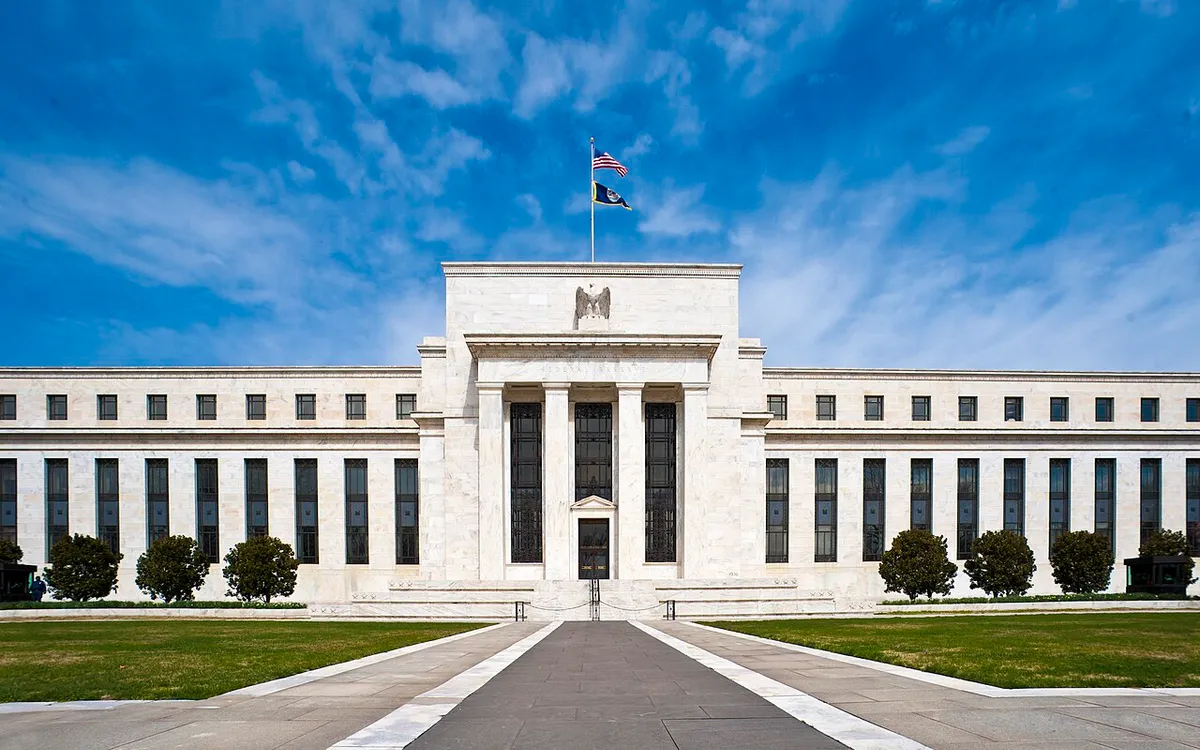
Markets price a September hike. The Fed's trimmed mean reads 2.3%.
Core PCE runs 3.3%. The Dallas Fed's trimmed mean runs 2.3%. That gap opened twice since 1980, and it closed in opposite directions each time.

By the numbers
2.3%the Dallas Fed's trimmed mean PCE inflation rate over the 12 months to July 2026
3.3%core PCE over the same 12 months, the reading the rate debate is built on
1.06 ptsthe gap between the two, the widest since April 2022
+23 bpthe move in the 2-year Treasury since the day before Warsh spoke at Jackson Hole
3.50-3.75%the fed funds target, held 9-3 on 29 July with three votes to raise it
The Federal Reserve's rate-setting committee meets on 15 and 16 September, and traders using the CME's FedWatch tool put the odds of a quarter-point rise at about 56% as of 8 September, up from roughly 30% before Chairman Kevin Warsh spoke at Jackson Hole. The case for raising rests on core PCE inflation, which ran 3.3% in the 12 months to July against a 2% target.
The Dallas Fed publishes a second reading of that same index. Trimmed mean PCE throws out the largest price moves in both tails every month and averages what is left. It reads 2.3% over 12 months, 2.3% annualized over six months, and 2.2% in July alone.
Two measures, one dataset, 1.06 points apart. That is the widest they have been since April 2022, and it has opened this far three times since 1978. Each time it closed. In 1983 core came down to meet the trim. In 2021 the trim went up to meet core, and the Fed spent the following two years repairing what it had called transitory. Which of those is repeating decides whether a hike on the 16th is cheap insurance or a rate rise aimed at a barrel of oil.
Four readings of the same economy
3.7%3.3%2.5%2.3%
View as table
| label | Four readings of US inflation, 12 months to July 2026 |
|---|---|
| Headline PCE | 3.7% |
| Core PCE | 3.3% |
| Core CPI | 2.5% |
| Trimmed mean PCE | 2.3% |
Headline PCE rose 3.7% in the year to July and core PCE 3.3%. Core CPI, the number most coverage quotes, rose 2.5% over the same year. Trimmed mean PCE rose 2.3%.
The spread between core PCE and core CPI is its own oddity. Core PCE now runs 0.88 points above core CPI, and the last month it ran that far ahead was October 1983 (calculated from PCEPILFE and CPILFESL, both 12-month percent change). The two indexes weight the same country differently and price some of it from different sources, so they drift apart. They do not usually drift apart like this.
The CPI detail shows where the headline overshoot comes from. Energy rose 14.7% over the year and gasoline 24.6%. Shelter rose 3.2%, medical care 1.7%, transportation services 2.9%, and used cars and trucks fell 1.9%. The July FOMC statement said as much in its own words, describing inflation as elevated "in part reflecting supply shocks that have driven price increases in certain sectors, including energy."
What the trimmed mean is for
A trimmed mean exists to answer one question: how much of this month's inflation is everything, and how much is a few things. Each month the Dallas Fed ranks every PCE component by price change, cuts the extremes off both ends, and averages the middle. What survives is the part of inflation that is broad.
At 2.3% over 12 months and 2.3% annualized over six, the broad part of US inflation is sitting within a rounding error of the Fed's target. The 1.3-point overshoot in core PCE is concentrated, and the trim is where it goes.
That is the strongest available argument against moving in September, and it comes from a Federal Reserve bank rather than from a market commentator.
1983 and 2021: same gap, opposite endings
The gap between core PCE and the trimmed mean has reached 1.0 point in three episodes since 1978: 1980-81, 1982-83, and April 2021 to April 2022. It is there again now, at 1.06 points in July after 1.08 in June.
In July 1983 the trim read 3.8% and core read 5.0%. Six months later core had fallen to 3.9% while the trim had barely moved, at 3.6%. The outliers reversed, core came down, and the trim had been right about where inflation actually was.
In April 2021 the trim read 1.9% and core read 3.1%. Twenty months later the trim read 4.9% and core read 5.0%. The outliers did not reverse. They spread, one category at a time, until the thing that had been concentrated was general, and by then the Fed was raising rates in 75-basis-point steps.
Same signal, opposite resolutions. A trimmed mean tells you inflation is narrow today. It cannot tell you whether narrow inflation stays narrow, and that is exactly the question in front of the committee next week.
The bond market has already paid for September
Look at what moved after Warsh spoke on 28 August, and how far along the curve it moved.
On 27 August, the day before the speech, the 2-year Treasury yielded 4.20%, the 10-year 4.67% and the 30-year 5.19%. On 9 September the 2-year yielded 4.43%, the 10-year 4.83% and the 30-year 5.28%. That is 23 basis points at the front, 16 in the middle, 9 at the back.
Twenty-three basis points on a two-year note is roughly what one extra quarter-point of policy rate is worth if you hold it across the note's life. The front end has done the repricing. And at 4.43% the 2-year now sits 81 basis points above the 3.625% midpoint of the current target range, which is more tightening than a single move accounts for.
The long end moved least, and the curve flattened with it: the 10-year's premium over the 2-year narrowed from 47 basis points to 40. That is the shape a bond market takes when it expects tighter policy now and lower rates later, which is a market betting the tightening works. Corporate borrowers are paying for the same shift: September's investment-grade issuance calendar is being priced into a curve that has lifted every week since Jackson Hole.
The committee was split before Warsh said anything
Coverage has treated the Jackson Hole keynote as the moment the hike appeared. The Fed's own paperwork puts it earlier.
In the June projections, the median participant put the fed funds rate at 3.8% at the end of 2026, above the 3.625% midpoint the committee has held since. The same round put the end-2027 median at 3.6% and the longer-run median at 3.1%, so June's committee expected to raise this year and come back down next. June's median for core PCE was 3.3% for the fourth quarter of this year, which is where the July reading landed, and unemployment at 4.3%.
Then on 29 July the committee held at 3.50-3.75% by 9 votes to 3. Beth Hammack, Neel Kashkari and Lorie Logan all preferred a quarter-point increase. Three named officials had already voted for the move that markets started pricing a month later.
What Warsh added on 28 August was a standard, not a forecast. He called the 2% objective "a firm, fixed target" and said the committee must "be confident that underlying inflation is moving to our objective, clearly and at sufficient speed. Otherwise, we have work to do." Our read of that speech at the time was that the rate signal had already been sent in July, and the June dots and the July dissents say the same thing.
What would break this read
Four things, honestly.
The trim removes exactly what a supply shock hits. Energy is the largest mover in the July data, and a measure built to discard large movers will discard it. If oil stays expensive for years, the shock stops being an outlier, works into freight, airfares and utilities, and turns up inside the trimmed mean. That is the 2021 path.
The stated case rests on expectations. Warsh's argument is about confidence in the path. A central bank that waits for broad inflation to confirm a narrow shock has already lost the argument it is trying to win.
Part of the 2-year move is term premium. A yield is expected policy plus compensation for holding duration. You cannot split the 23 basis points into "hikes" and "risk" from the yield alone, so treat the one-hike arithmetic as an approximation.
The labor market is not asking for relief. August payrolls added 162,000 jobs, which removes the usual reason to leave rates alone.
What to watch between now and the 16th
August producer prices land on 10 September and August CPI on 11 September. Both matter more than usual, because August PCE is not published until 30 September, two weeks after the vote. The committee decides with July's 3.3% as its last official reading of its own target measure, while the staff build an August estimate out of the CPI and PPI source data.
Then there is the part nobody has priced. The 16th is a projections meeting, so a new dot plot replaces June's. The quarter-point is largely in the market already. The 2027 median, and how far above 3.6% it moves, is the number that has not been paid for yet.
Sources
- FOMC calendar and meeting dates, Federal Reserve
- FOMC statement, 29 July 2026, Federal Reserve
- Summary of Economic Projections, 17 June 2026, Federal Reserve
- Keynote remarks by Chairman Warsh, Jackson Hole, 28 August 2026, Federal Reserve
- Personal Income and Outlays, July 2026, released 26 August 2026, Bureau of Economic Analysis
- Trimmed Mean PCE Inflation Rate, July 2026, released 26 August 2026, Federal Reserve Bank of Dallas
- Consumer Price Index, July 2026, released 12 August 2026, Bureau of Labor Statistics
- Daily Treasury Par Yield Curve Rates, 2026, US Department of the Treasury
- Core PCE price index, 12-month change and trimmed mean PCE and core CPI, FRED, series retrieved 10 September 2026
- CME FedWatch odds for the September 2026 meeting, 8 September 2026, Yahoo Finance
- CPI release schedule and PPI release schedule, Bureau of Labor Statistics; BEA release schedule
This is not financial advice.
More from Markets
New homes sell $35,400 under resales. Builders stopped replacing them.
The median new home sold $35,400 below the median resale in August as 43% of builders cut prices. September permits fell to their lowest since 2023.