
FinCEN cuts MEXC off December 10. Binance cut it off in 4 days.
FinCEN's ban on MEXC starts December 10. Binance, OKX and Gate began holding MEXC transfers within four days, and a wallet detour won't clean the coins.
By the numbers
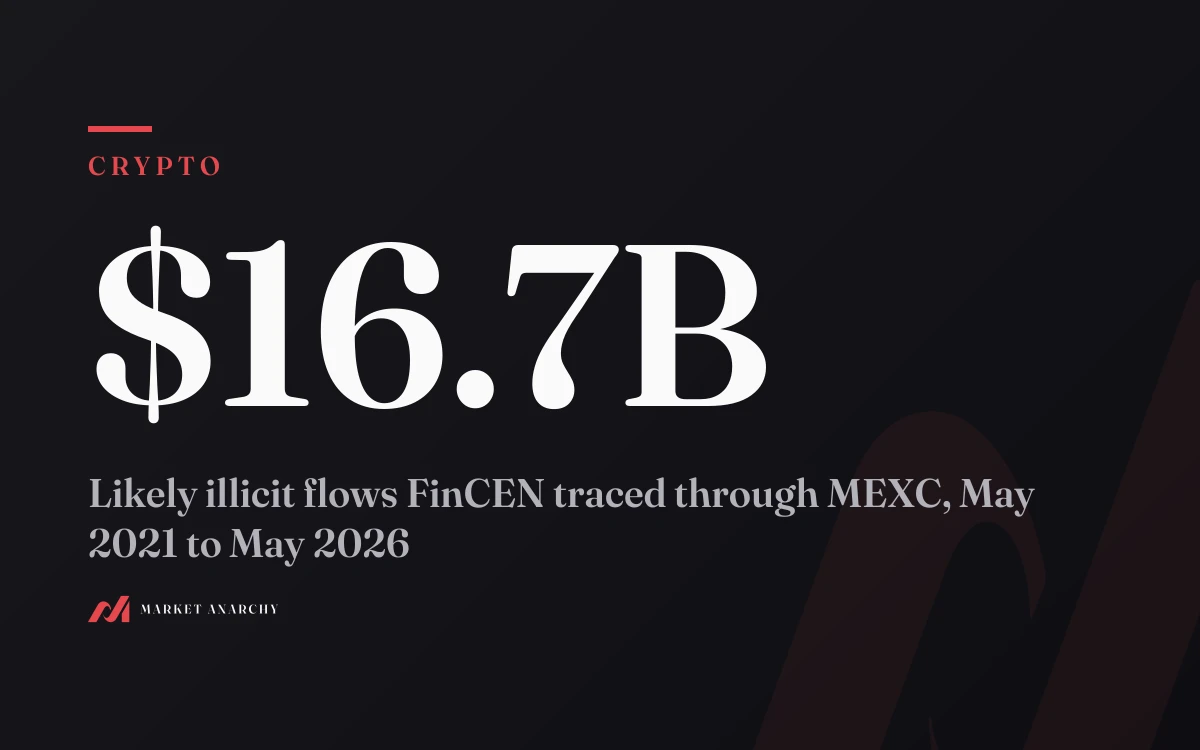
$16.7Blikely illicit flows FinCEN traced through MEXC, May 2021 to May 2026
Dec 10the day US banks and exchanges must stop all transfers to and from MEXC
4 daysfrom Treasury's announcement to Binance halting MEXC transfers
$489Mdrop in MEXC's tracked reserves, November 5 to 10, prices included
The US ban on MEXC starts on December 10, 2026. For anyone holding coins there, the real deadline came sooner. FinCEN announced the order on November 6 and it ran in the Federal Register on November 10. It binds only US financial institutions. By that same Tuesday, Binance had stopped sending funds to MEXC and started holding deposits from it, and users were reporting MEXC transfers flagged at OKX and Gate. None of those exchanges is covered by the order.
So the exits are closing on the offshore exchanges' schedule, a month ahead of Washington's. And the order's own text says a coin can still count as MEXC money after it has sat in a personal wallet.
What the order does, and to whom
The order names MEXC Global, a Seychelles company, plus its current and former affiliates in Estonia, Switzerland, the UK and Singapore, and any successor. From December 10, a "covered financial institution" may not send funds to MEXC or receive funds from it. The order defines funds to include crypto. It has no end date.
Covered institutions are the ones US law already calls financial institutions: banks, broker-dealers and money transmitters, which includes US-registered crypto exchanges. Any MEXC office inside the US is carved out.
It is a ban on transfers. MEXC is not on OFAC's sanctions list, and nothing in the order freezes a customer's balance, as 24/7 Wall St. notes. FinCEN used section 9714 of the Combating Russian Money Laundering Act, the same tool it used on Bitzlato in January 2023 and on PM2BTC in September 2024.
What FinCEN says went through MEXC
The figures come from FinCEN's own blockchain analysis, published in the order. They overlap, so they don't add up to the total:
- $16.7 billion in likely illicit activity between May 2021 and May 2026.
- Nearly $1.5 billion with direct and indirect exposure to Russian sanctions evasion, including $232 million straight to sanctioned entities.
- About $129 million with Garantex and $4.1 million with its successor Grinex after both were sanctioned, as recently as June 2026.
- About $1.87 billion with exposure to Iran, more than $1 billion of it in direct trades with over 40 Iranian exchangers. MEXC's own user agreement bars Iran.
- At least $1.99 billion to or from cybercrime actors, and $37.9 million in suspected ransomware payments from January 2022 to July 2024.
FinCEN also puts MEXC's size on the record: about $1 billion a day in transactions and $5 billion in reserves as of June 2026. Regulators in Seychelles, Hong Kong and Japan had already flagged it for operating without a license.
Our read on scale: had MEXC moved $1 billion every day for five years, $16.7 billion would be under 1% of the flow. Volume was probably lower in the early years, so the real share is higher, and FinCEN doesn't publish the denominator. FinCEN says as much: it assumes part of MEXC's business is legitimate and rules that the illicit part outweighs it, because it is large, repeated, and got past MEXC's own written rules.
The offshore exchanges moved first
Nothing obliges Binance or OKX to follow a FinCEN order. They followed it anyway, inside a week:
- Binance, November 10: rejects withdrawals to MEXC and 13 related entities, holds incoming MEXC deposits for compliance review, and may restrict or offboard accounts involved, per Decrypt.
- OKX: CEO Star Xu said OKX treats FinCEN special measures "with a level of caution similar to sanctions" and that funds tied to affected platforms "may be frozen," per Bitcoin.com News.
- Gate and Bitget Wallet: users reported MEXC deposits delayed or sent to refund review, and Bitget Wallet's card service stopped taking funds identified as coming from MEXC, per TokenPost.
Why so fast? Our read: a big exchange that wants to keep its US banking partners, stablecoin issuers and listed-company clients can't afford to look like MEXC's side door. Cutting MEXC off costs them very little. Getting caught as the route the money took after December 10 could cost them a lot.
The wallet detour doesn't clean anything
FinCEN wrote one passage for US exchanges that also tells MEXC users something. US platforms can't always refuse crypto before it lands. So the order lets them use discretion where coins "originated from MEXC Global, but were held for an extended period of time in an unhosted wallet," in its words.
Put plainly, moving coins from MEXC to your own wallet and on to Coinbase a few weeks later doesn't make them new coins. The chain shows where they came from, and the regulator has told US exchanges they may act on it. Withdrawing your own money is legal. Trying to disguise where it came from is a different act, and it is the act that gets accounts closed.
What holds up is a paper trail. Keep the MEXC withdrawal records: the date, the amount, the transaction hash and your account history. If a regulated exchange asks where a deposit came from, that file is the answer.
What the reserves show so far
DefiLlama's tracked MEXC wallets held $4.58 billion at the start of November 5 and $4.09 billion late on November 10, a drop of about 11%. Part of that is price, since bitcoin fell below $74,000 on November 10 after a hot CPI print. The coin counts strip that out. ETH held fell from about 4,435 to 2,655, a 40% drop. BTC slipped about 3%, from 11,793 to 11,406. USDT fell from $1.67 billion to $1.53 billion, then partly came back.
CryptoSlate counted $126 million in net outflows in the 24 hours around the announcement. MEXC says withdrawals stay open. It has started an independent review of its controls and is working with Elliptic to get its addresses reclassified, per Bitcoin.com News.
So far the numbers look like steady withdrawals. Tracked wallets also stop short of a balance sheet: they show what MEXC holds and say nothing of what it owes its customers.
What would make it worse
The risk that matters for a MEXC balance is a stablecoin issuer acting on its own. Tether froze about $27 million in USDT at Garantex on March 6, 2025, and Garantex stopped trading and withdrawals the same day. Garantex was already under OFAC sanctions. MEXC isn't, so a Tether freeze would be a bigger step for Tether than that one was. But USDT is MEXC's largest single holding in DefiLlama's data, about $1.56 billion of $4.09 billion, so a freeze would hit the asset customers lean on most.
Watch three things before December 10: whether Tether or Circle freeze any MEXC address, whether MEXC's withdrawal queues slow down, and whether more exchanges copy Binance. Any one of them shortens the window.
If you trade on MEXC from outside the US, your account sits outside the order. Its exits sit inside it, and they are closing now. For background on how fast a stablecoin route can shut, see how stablecoins froze in 37 minutes after Binance's $6.3 billion loss. For what a reserve page does and doesn't prove, see Binance's USDT cushion.
Sources
- FinCEN order on MEXC Global, Federal Register, November 10, 2026
- US Treasury press release, November 6, 2026
- Decrypt: Binance halts MEXC transfers, November 10, 2026
- Bitcoin.com News: OKX freezes MEXC user deposits, November 8, 2026
- TokenPost: MEXC transfers flagged at OKX, Binance and Gate, November 2026
- DefiLlama: MEXC tracked reserves
- CryptoSlate: MEXC sees $126 million outflows, November 2026
- The Block: Bitcoin slides below $74,000 after CPI, November 10, 2026
- 24/7 Wall St.: what happens to crypto held on MEXC, November 7, 2026
- FinCEN: Bitzlato order, January 2023
- FinCEN: PM2BTC order, September 2024
- Cointelegraph: Tether freezes $27 million USDT at Garantex, March 2025
This is not financial advice.
More from Crypto
Binance lost $6.3B. Stablecoins froze in 37 minutes. Bitcoin can't.
Tether, Circle and two smaller issuers froze about $2.4B of the stolen Binance stablecoins. The 18,270 BTC and $911M in ETH and TRX stay with the attacker.