



ACA open enrollment 2027: dates, income limits, what you'll pay
Open enrollment runs November 1 to January 15; the December 15 end was struck down. Above $63,840 one person gets no 2027 subsidy. What you'll pay.
By the numbers
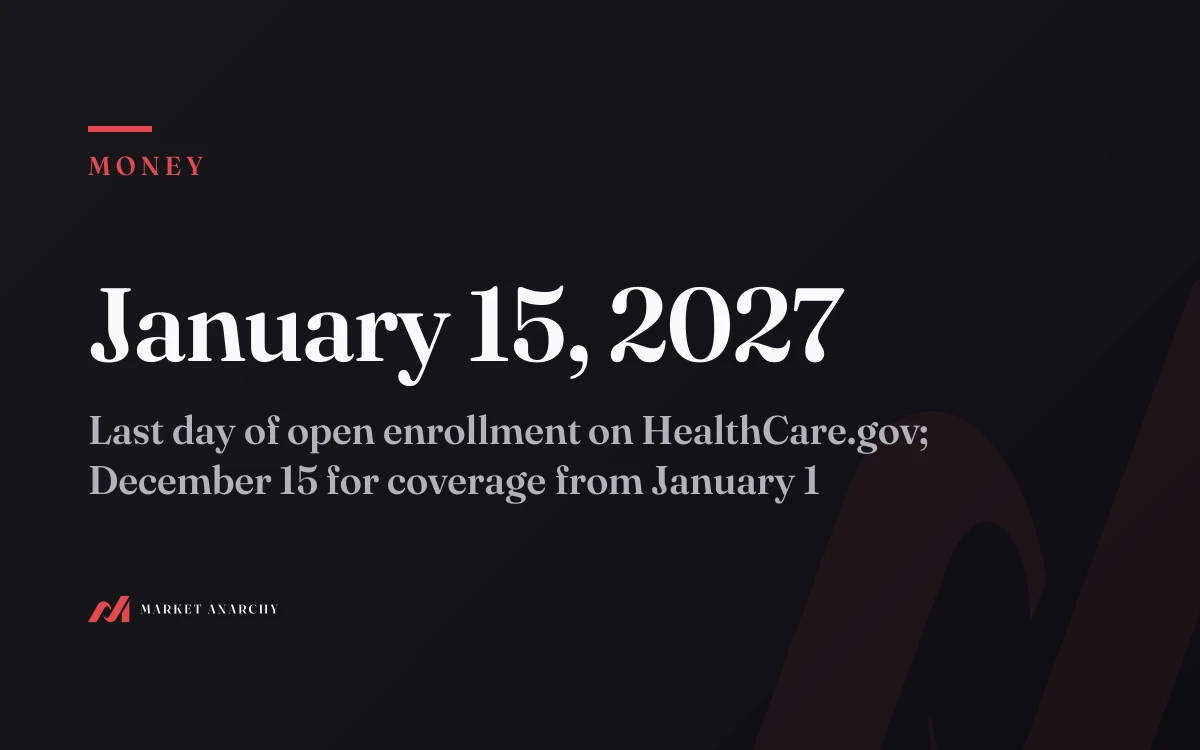
January 15, 2027last day of open enrollment on HealthCare.gov; December 15 for coverage from January 1
$63,840the 2027 income above which a single person gets no subsidy
10.22%the most of your income you pay for the benchmark silver plan below that line
15%the median 2027 premium increase insurers filed
Open enrollment for 2027 Marketplace coverage on HealthCare.gov runs from November 1, 2026 to January 15, 2027. Sign up by December 15 and your coverage starts January 1. Sign up between December 16 and January 15 and it starts February 1. The December 15 end date some guides still print was struck down in court in June. Subsidies for 2027 go to households between 100% and 400% of the poverty line, which for one person tops out at $63,840. Below that line you pay at most 10.22% of your income for the benchmark silver plan. Above it you pay full price, and insurers filed a median increase of 15%.
If you're self-employed, one number decides all of it: the 2027 net profit you estimate on the application and settle on your tax return.
The 2027 dates
| Date | What happens | Source |
|---|---|---|
| November 1, 2026 | Open enrollment opens | HealthCare.gov, Dates and deadlines, checked October 18, 2026 |
| December 15, 2026 | Last day to enroll or change plans for coverage from January 1 | HealthCare.gov, same page |
| January 15, 2027 | Open enrollment ends; coverage from February 1 | HealthCare.gov, same page |
A CMS rule finalized in June 2025 would have ended open enrollment on HealthCare.gov on December 15, starting with 2027 coverage. On June 12, 2026 the federal district court in Maryland vacated that provision in City of Columbus v. Kennedy, along with others from the same rule (Baldwin, July 29, 2026). HealthCare.gov's own calendar now lists January 15. The same plaintiffs filed a new suit on July 16, 2026 against the rule HHS wrote for 2027, so the calendar page is the one to check before you count on the last week.
If your state runs its own marketplace, its dates can differ. HealthCare.gov sends you to it when you enter your state.
Who gets help: the 2027 income limits
The premium tax credit for 2027 goes to households between 100% and 400% of the federal poverty line, measured on the 2026 guidelines (HealthCare.gov, federal poverty level). For the 48 contiguous states and DC:
| Household | 100% of the poverty line | 400%: where the subsidy ends |
|---|---|---|
| 1 person | $15,960 | $63,840 |
| 2 people | $21,640 | $86,560 |
| 3 people | $27,320 | $109,280 |
| 4 people | $33,000 | $132,000 |
The guidelines are higher in Alaska and Hawaii. The help above 400% that people got from 2021 to 2025 is gone: the IRS writes that Congress lifted the ceiling only "for tax years 2021 through 2025" (IRS, Questions and answers on the Premium Tax Credit, updated September 21, 2026).
What you pay below the line
The credit caps what you pay for the benchmark plan, the second-cheapest silver plan where you live, at a share of your income. The share rises with income, on the table the IRS set for 2027 in Revenue Procedure 2026-26 (July 21, 2026):
| Income as a share of the poverty line | Share of income you pay for the benchmark plan |
|---|---|
| Under 133% | 2.15% |
| 133% to 150% | 3.23% rising to 4.3% |
| 150% to 200% | 4.3% rising to 6.78% |
| 200% to 250% | 6.78% rising to 8.66% |
| 250% to 300% | 8.66% rising to 10.22% |
| 300% to 400% | 10.22% |
For one person, that works out like this:
| 2027 income, one person | Share of the poverty line | The benchmark plan costs you | A month |
|---|---|---|---|
| $20,000 | 125% | $430 a year | about $36 |
| $30,000 | 188% | $1,855 a year | about $155 |
| $40,000 | 251% | $3,472 a year | about $289 |
| $50,000 | 313% | $5,110 a year | about $426 |
| $63,840 | 400% | $6,524 a year | about $544 |
The arithmetic is ours, on the IRS table and the 2026 guidelines. The credit is the same whatever plan you pick, so a cheaper bronze plan can cost you less than this and a gold plan costs you the difference. HealthCare.gov's estimate on your own household is the number to trust.
$36$155$289$426$544
View as table
| label | What one person pays a month for the 2027 benchmark plan |
|---|---|
| $20,000 income | $36 |
| $30,000 income | $155 |
| $40,000 income | $289 |
| $50,000 income | $426 |
| $63,840 income | $544 |
What one dollar over the line costs
Above 400% the credit is zero and you pay the plan's full price, which depends on your age and your county. KFF puts the 2026 average benchmark for a 40-year-old at $625 a month, up from $497 in 2025 (KFF State Health Facts). Insurers filed a median 15% increase for 2027, across 276 insurers in every state and DC (Peterson-KFF Health System Tracker, updated August 3, 2026).
If the average moves by that median, a 40-year-old at $63,840 pays about $544 a month for a plan that costs about $719 a month at $63,841. That's roughly $2,100 more for the year, for one dollar of income. It's an estimate on national averages, and an older buyer in an expensive county stands to lose more.
The bill arrives at tax time. The credit is paid to your insurer during the year on your estimate, then settled on your return, and the same IRS page says "there is no repayment cap for tax years after 2025." Finish the year above the line after twelve months of advance credit and you hand all of it back. Below the line the old repayment caps are gone too, which we worked through in the repayment piece.
If you're self-employed, the estimate is the whole game
HealthCare.gov asks you for "net income from your self-employment" and tells you to "do your best to estimate your self-employment income and expenses for the year accurately, based on your past experience, realistic expectations, industry standards, and other information" (HealthCare.gov, self-employed income). It also asks you to update the application as soon as your income changes.
The credit is measured on modified adjusted gross income. With no tax-exempt interest, foreign income or Social Security to add back, that's your adjusted gross income: net profit minus the deductible half of self-employment tax and the other adjustments on Schedule 1 (IRS Publication 974). Three of those adjustments are yours to set:
- Pre-tax retirement contributions. Money into a SEP IRA or a solo 401(k) comes off before the line is measured, and it can go in until you file. We set out what each plan takes for 2026 in the solo 401(k) and SEP comparison.
- A health savings account. Bronze and catastrophic Marketplace plans have counted as HSA-compatible since January 1, 2026 (IRS, Notice 2026-05, December 9, 2025). For 2027 you can put in up to $4,500 with self-only coverage or $9,000 with family coverage (IRS, Revenue Procedure 2026-24, May 29, 2026).
- The self-employed health insurance deduction. The premiums you pay yourself come off your income, which raises your credit, which lowers the premiums you pay. Publication 974 has the IRS's method for working out where that loop settles.
When your income swings, the safer error is the high one. Estimate too high and you get the rest of your credit back at filing. Estimate too low and, since 2026, you repay every dollar of the excess.
Before January 15
- Want coverage from January 1? Enroll or change plans by December 15. After that, through January 15, coverage starts February 1.
- Estimate 2027 from this year's books. Your 2026 net profit, adjusted for clients you have already won or lost, is better evidence than a hope.
- Near the line? Plan the retirement and HSA contributions now. They're the adjustments that can bring a 2027 income back under $63,840 for one person, and you can still make them after the year ends.
What changed
- October 18, 2026. First published, with the 2027 dates from HealthCare.gov, the applicable percentages from IRS Revenue Procedure 2026-26, the 2026 poverty guidelines and the median filed increase from Peterson-KFF's update of August 3, 2026.
Sources
- HealthCare.gov, Dates and deadlines (checked October 18, 2026)
- Baldwin, District court vacates key portions of ACA Marketplace Integrity rule (July 29, 2026)
- HealthCare.gov, Federal poverty level (2026 guidelines)
- Internal Revenue Service, Questions and answers on the Premium Tax Credit (updated September 21, 2026)
- Internal Revenue Service, Revenue Procedure 2026-26 (July 21, 2026)
- KFF, Marketplace average benchmark premiums (2025 and 2026)
- Peterson-KFF Health System Tracker, How much and why ACA Marketplace premiums are going up in 2027 (July 8, 2026, updated August 3, 2026)
- HealthCare.gov, Self-employed income
- Internal Revenue Service, Publication 974, Premium Tax Credit
- Internal Revenue Service, Treasury, IRS provide guidance on new tax benefits for health savings account participants (Notice 2026-05, December 9, 2025)
- Internal Revenue Service, Revenue Procedure 2026-24 (May 29, 2026)
This is not financial advice.
More from Money
Solo 401(k) vs SEP IRA 2026: limits, deadlines, which saves more
At $60,000 of net profit, a solo 401(k) takes $35,652 for 2026 and a SEP IRA $11,152. The limits, the deadlines and when the SEP still wins.