


Solo 401(k) vs SEP IRA 2026: limits, deadlines, which saves more
At $60,000 of net profit, a solo 401(k) takes $35,652 for 2026 and a SEP IRA $11,152. The limits, the deadlines and when the SEP still wins.
By the numbers
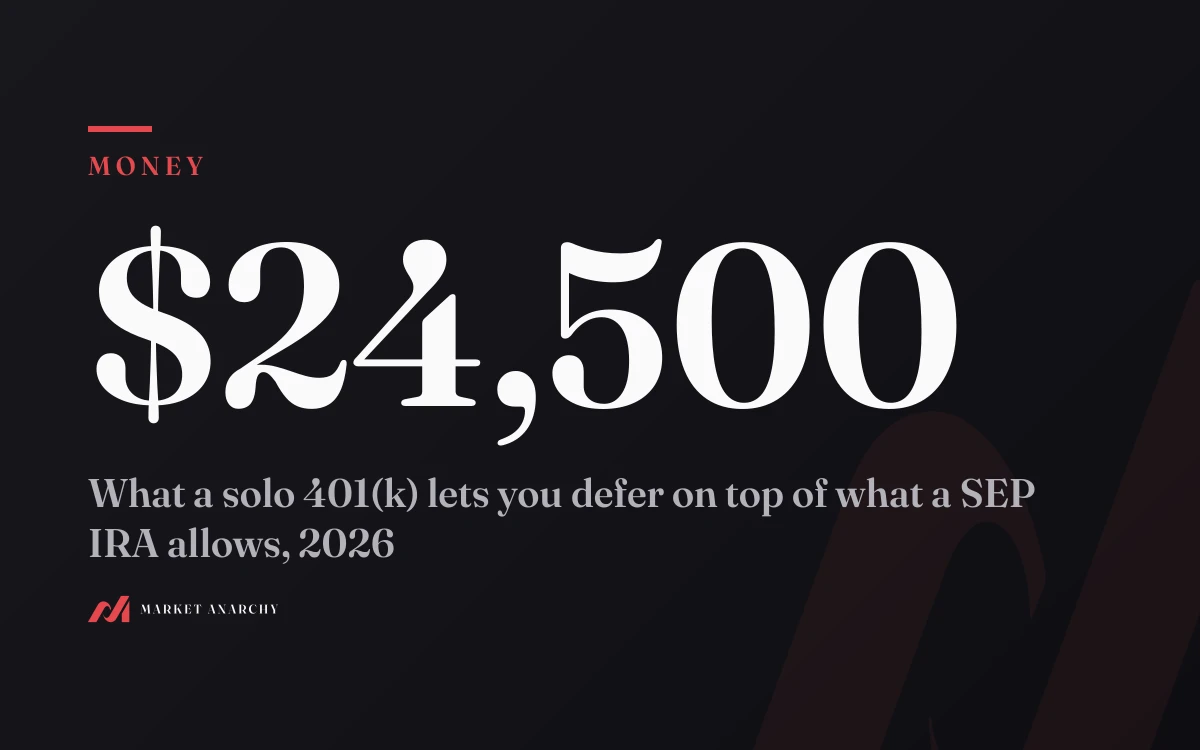
$24,500what a solo 401(k) lets you defer on top of what a SEP IRA allows, 2026
$72,000the 2026 ceiling for either plan, before catch-ups
April 15, 2027last day to open a first solo 401(k) and still defer for 2026
$62,600the modified AGI where a single filer's 2026 Marketplace subsidy ends
If you freelance with no employees, a solo 401(k) holds more for 2026 than a SEP IRA at any net profit below about $376,500. Both plans take an employer contribution of 20% of your net profit after half your self-employment tax. Only the solo 401(k) adds an employee deferral of up to $24,500 on top. At $60,000 of net profit that's $35,652 against $11,152. Both stop at $72,000 before catch-ups. A first solo 401(k) can still be opened for 2026 until April 15, 2027, deferral included. After that date the two plans give you the same 20%, and the SEP is the one with less paperwork.
The limits below are the IRS's, each with the date the IRS published it. The table of what each plan takes at your income is our arithmetic on the IRS's own method, laid out step by step.
The 2026 limits, side by side
| Solo 401(k) | SEP IRA | Source | |
|---|---|---|---|
| Employee deferral | Up to $24,500 | None | IRS Notice 2025-67, November 13, 2025 |
| Employer contribution | 20% of net profit after half your self-employment tax | The same 20% | IRS Publication 560, 2025 edition |
| Ceiling, before catch-ups | $72,000 | $72,000 | Notice 2025-67 |
| Catch-up at 50 and over | $8,000 on top | Not allowed | Notice 2025-67; IRS, SEP contribution limits, June 28, 2026 |
| Catch-up at 60 to 63, in place of the $8,000 | $11,250 on top | Not allowed | Notice 2025-67 |
| Most pay a plan can count | $360,000 | $360,000 | Notice 2025-67 |
| Who can be in it | You, or you and your spouse | You and every eligible employee, at the same percentage | IRS, One-participant 401(k) plans, April 9, 2026; IRS, SEP FAQs, August 1, 2026 |
| Yearly filing | Form 5500-EZ once the plan holds $250,000 at year-end | None | IRS, One-participant 401(k) plans |
The employer side is identical in both plans. The deferral is where they part. A SEP has no employee side at all, so the $24,500 is the whole difference for anyone whose profit leaves room for it.
Catch-ups sit outside the ceiling. In the IRS's words, total contributions, "not counting catch-up contributions, cannot exceed the overall limit." So a 61-year-old with enough profit can put up to $83,250 into a solo 401(k) for 2026. A SEP tops out at $72,000.
What each plan takes at your net profit
Net profit is the bottom line of your Schedule C. Self-employment tax runs on 92.35% of it: 12.4% up to the 2026 Social Security wage base of $184,500 (IRS Publication 15, 2026), plus 2.9% on all of it. Half of that tax comes off. The plan's 25% then works out to 20% of what's left, the rate in the Rate Table for Self-Employed in Publication 560. We set out the self-employment tax itself in what freelancers owe the IRS in 2026. The table assumes one business, no W-2 job and no employees.
| Net profit, 2026 | SEP IRA | Solo 401(k), under 50 | Solo 401(k), 50 and over | Solo 401(k), 60 to 63 |
|---|---|---|---|---|
| $40,000 | $7,435 | $31,935 | $37,174 | $37,174 |
| $60,000 | $11,152 | $35,652 | $43,652 | $46,902 |
| $80,000 | $14,870 | $39,370 | $47,370 | $50,620 |
| $100,000 | $18,587 | $43,087 | $51,087 | $54,337 |
| $150,000 | $27,881 | $52,381 | $60,381 | $63,631 |
| $200,000 | $37,177 | $61,677 | $69,677 | $72,927 |
| $250,000 | $47,043 | $71,543 | $79,543 | $82,793 |
| $300,000 | $56,909 | $72,000 | $80,000 | $83,250 |
At $40,000 the catch-up runs into a second limit: what goes in can't exceed what you earned after half your self-employment tax, here $37,174. For anyone under 50, the gap between the plans is exactly $24,500 at every row until the solo 401(k) reaches its ceiling, at about $252,300 of net profit. The SEP keeps climbing and meets it at about $376,500, where the 20% alone comes to $72,000.
$18587$43087$51087$54337
View as table
| label | Most you can put in for 2026 at $100,000 of net profit |
|---|---|
| SEP IRA | $18587 |
| Solo 401(k), under 50 | $43087 |
| Solo 401(k), 50 and over | $51087 |
| Solo 401(k), 60 to 63 | $54337 |
The deadlines for 2026 money
| What you're doing | Deadline | Source |
|---|---|---|
| Open your first solo 401(k) and defer for 2026 | April 15, 2027, with no extension | IRS Publication 560, 2025 edition; Ed Slott and Company, February 27, 2023 |
| Elect a deferral into a solo 401(k) you already have | December 31, 2026 | IRS Publication 560 |
| Deposit that deferral and the employer contribution | Your filing deadline with extensions | IRS Publication 560 |
| Open a new solo 401(k) for the employer contribution only | Your filing deadline with extensions | IRS Publication 560 |
| Open a SEP IRA and fund it | Your filing deadline with extensions: April 15, 2027, or October 15, 2027 if you extend | IRS, SEP FAQs, August 1, 2026 |
The first row changed in 2023. Until then a solo 401(k) set up after December 31 could only take employer money, so deciding in the spring meant losing the deferral. SECURE 2.0 changed that for a plan's first year. Publication 560: "For 2023 and later years, a sole proprietor with no employees can adopt a section 401(k) plan after the end of the tax year, provided the plan is adopted by the tax filing deadline (without regard to extensions)." The first year's deferrals can go in by that same date.
Two limits come with it. It works once, for the plan's first year; from then on the December 31 election applies. And it covers a business you own outright with no employees besides a spouse, which means a sole proprietorship or a single-member LLC taxed as one. An S-corporation owner is on payroll, and payroll deferrals come out of paychecks dated in the year.
Without a plan by April 15, the deferral is gone for 2026. The 20% stays open in either plan until your extended deadline, and at that point the SEP is the simpler way to take it.
When the SEP IRA is the better pick
You have employees. A solo 401(k) covers an owner with no employees, or an owner and spouse. A SEP has to give every eligible employee the same percentage of pay you give yourself. Eligible means 21 or older, working for you in at least 3 of the last 5 years, and paid at least $800 in 2026 (Notice 2025-67; IRS, SEP FAQs).
A day job already takes your deferral. The $24,500 is per person. The IRS tells you to "aggregate all elective deferrals you made to all plans in which you participate." If your employer's 401(k) gets the full amount, the solo 401(k) has no extra room, and both plans give your side business the same 20%. The ceiling runs the other way: "the limit on annual additions applies to each plan separately," so your own plan keeps its own $72,000 (IRS, 401(k) contribution limits, April 8, 2026).
Your net profit is above about $376,500. Both plans reach $72,000. Unless you're 50 or over and want the catch-up, the SEP gets you there with no Form 5500-EZ.
Two 2026 rules that favor the solo 401(k)
The new Roth catch-up rule leaves you out. From 2026, anyone who earned more than $150,000 in FICA wages in 2025 has to make catch-up contributions as Roth (Notice 2025-67; IRS, IR-2025-91, September 15, 2025). Income from self-employment isn't FICA wages, and BDO's reading of the final regulations, October 28, 2025, puts self-employed people without them outside the rule. A sole proprietor can keep catch-ups pre-tax. An S-corporation owner paid a W-2 above $150,000 can't.
A SEP balance gets in the way of a backdoor Roth. If your income is above the Roth IRA limits and you convert through a traditional IRA, Form 8606 counts every traditional, SEP and SIMPLE IRA balance you hold on December 31 when it works out how much of the conversion is taxable. A 401(k) balance stays out of that sum (Instructions for Form 8606, 2025). Money in a SEP makes part of each conversion taxable. The same money in a solo 401(k) stays out of the math.
What a pre-tax dollar is worth in 2026
Pre-tax money in either plan comes off your adjusted gross income dollar for dollar. Two rules move what that dollar is worth.
Near the ACA subsidy cliff, it's worth the most. Congress lifted the 400% ceiling on the premium tax credit only "for tax years 2021 through 2025" (IRS, Questions and answers on the Premium Tax Credit, updated September 21, 2026). For 2026 Marketplace coverage the credit ends above 400% of the 2025 poverty line: $62,600 for a single filer in the 48 contiguous states and DC, four times the $15,650 HHS published on January 17, 2025.
So a single filer whose 2026 modified AGI lands at $66,000 hands back every dollar of advance credit received during the year. $3,500 into either plan before filing brings it to $62,500 and the credit back. Below the line the same dollars still count: a lower MAGI means a larger credit and a smaller bill at filing, and the same IRS page says "there is no repayment cap for tax years after 2025." We worked through the cliff by household size in the ACA repayment piece.
With the QBI deduction, it's worth 80 cents on the dollar. The IRS lists contributions to qualified retirement plans among the deductions that count against your qualified business income (Instructions for Form 8995, 2025). If you take the 20% QBI deduction, $10,000 into either plan lowers your taxable income by about $8,000, because the QBI deduction shrinks by $2,000.
What to do before you file
- No plan yet and no employees. Open a solo 401(k) before April 15, 2027 and make the 2026 deferral by then. The 20% can follow until your extended deadline.
- A solo 401(k) already open. Put your 2026 deferral election in writing by December 31, 2026. The deposit can wait for your filing deadline.
- Employees, a day-job 401(k) that takes your deferral, or a decision after April 15. The SEP is the simpler plan, open until October 15, 2027 if you extend. With employees, budget for their share at the same percentage.
The 2027 limits
The IRS sets them from the consumer price index through September 2026. The 2026 limits came out on November 13, 2025. Milliman's projection of September 11, 2026: a deferral of $25,500, a ceiling of $75,000, a catch-up of $8,500 at 50 and over and $11,750 at 60 to 63, and pay counted up to $375,000 (Milliman). Until the IRS publishes, treat them as estimates.
What changed
- October 17, 2026. First published, with the 2026 limits from IRS Notice 2025-67 and Milliman's 2027 projection of September 11, 2026.
Sources
- Internal Revenue Service, Notice 2025-67, 2026 amounts relating to retirement plans and IRAs (November 13, 2025)
- Internal Revenue Service, Publication 560, Retirement Plans for Small Business (2025 edition)
- Internal Revenue Service, One-participant 401(k) plans (updated April 9, 2026)
- Internal Revenue Service, SEP contribution limits (updated June 28, 2026)
- Internal Revenue Service, Retirement plans FAQs regarding SEPs (updated August 1, 2026)
- Internal Revenue Service, 401(k) and profit-sharing plan contribution limits (updated April 8, 2026)
- Internal Revenue Service, Publication 15, Employer's Tax Guide (2026)
- Internal Revenue Service, Treasury, IRS issue final regulations on new Roth catch-up rule (IR-2025-91, September 15, 2025)
- BDO, IRS issues final catch-up contribution regulations (October 28, 2025)
- Ed Slott and Company, SECURE 2.0 allows retroactive solo 401(k) plans with elective deferrals (February 27, 2023)
- Internal Revenue Service, Instructions for Form 8606 (2025)
- Internal Revenue Service, Instructions for Form 8995 (2025)
- Internal Revenue Service, Questions and answers on the Premium Tax Credit (updated September 21, 2026)
- Department of Health and Human Services, Annual update of the HHS poverty guidelines (Federal Register, January 17, 2025)
- Milliman, 2027 IRS limits forecast (September 11, 2026)
This is not financial advice.
More from Money
ACA open enrollment 2027: dates, income limits, what you'll pay
Open enrollment runs November 1 to January 15; the December 15 end was struck down. Above $63,840 one person gets no 2027 subsidy. What you'll pay.