Your $200 AI plan now pays for 22,000 API calls. Then the app stops.
Claude Ultra and ChatGPT Pro now pay $200 a month in API credit. It buys about 22,000 mid-tier calls, expires each cycle, and stops your app at zero.
By the numbers
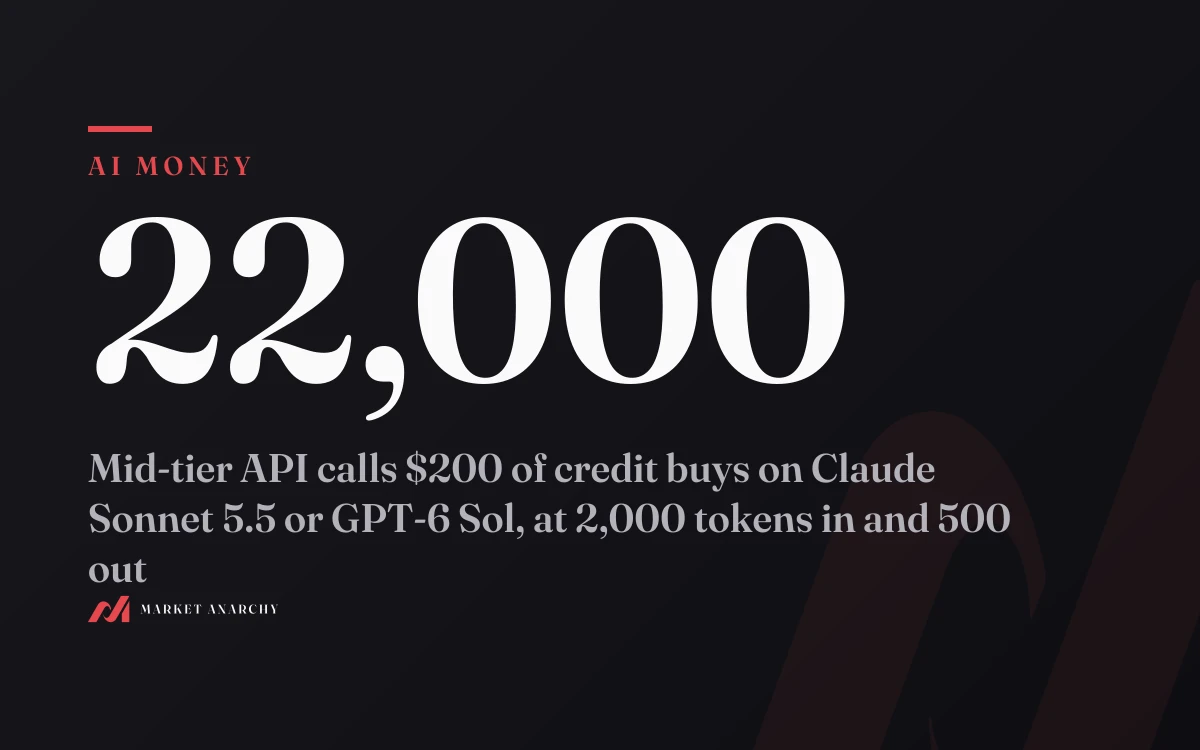
22,000mid-tier API calls $200 of credit buys on Claude Sonnet 5.5 or GPT-6 Sol, at 2,000 tokens in and 500 out
$200monthly API credit in Claude Ultra and the $200 ChatGPT Pro tier, the same as the plan's price
0days of rollover: unused credit expires at the end of each billing cycle on both
$500Anthropic's Start-tier monthly spend cap, where a Max or Ultra organization lands
If you pay $100 or $200 a month for Claude or ChatGPT, you now get the same amount back as API credit. OpenAI started on October 28: $100, $200 or $500 a month on ChatGPT Pro, matching the tier's price, and $20 or $100 per Business seat up to $500 a workspace. Anthropic's version pays $100 on Max, $200 on Ultra and up to $500 pooled on Team.
That's real money for anyone building a side product. At Sonnet 5.5 or GPT-6 Sol prices, $200 buys about 22,000 ordinary API calls a month. But the credit comes wired to a hard stop. When it runs out, an app running only on it goes dark until the next billing cycle, and whatever you didn't spend disappears. Treat it as a free prototype budget. Running paying customers on it alone means your product stops on a day you don't pick.
What the credit pays for
Both companies point the credit at their developer platforms and away from their coding tools.
On Claude, it covers the Claude API, Managed Agents, the Agent SDK and the Console playground. It doesn't cover Claude Code or extra usage in the Claude apps, and it works only in Anthropic's own Console, not on AWS, Google Cloud or Microsoft's platforms. Free, Pro and Enterprise plans get nothing.
On OpenAI, it covers the Responses, Agents and Realtime APIs, images and built-in tools. "Codex usage through API keys is not supported by this benefit."
Both make you wait seven days on a paid plan before you can claim, and both link the credit to one API organization you control.
What $200 buys, model by model
The credit is only as big as the model you spend it on. We priced one typical call at 2,000 input tokens and 500 output tokens, a chat turn with some context, using each company's list prices (Anthropic, OpenAI):
| Model | Input / output per million tokens | Cost per call | Calls per $200 |
|---|---|---|---|
| Claude Haiku 5.5 | $0.10 / $0.50 | $0.00045 | about 444,000 |
| GPT-6 Luna | $0.10 / $0.50 | $0.00045 | about 444,000 |
| Claude Sonnet 5.5 | $2 / $10 | $0.009 | about 22,000 |
| GPT-6 Sol | $2 / $10 | $0.009 | about 22,000 |
| Claude Opus 5.5 | $4 / $20 | $0.018 | about 11,000 |
| GPT-6 Astra | $10 / $50 | $0.045 | about 4,400 |
44422.211.14.4
View as table
| label | API calls $200 of credit buys, thousands |
|---|---|
| Haiku 5.5 / GPT-6 Luna | 444 |
| Sonnet 5.5 / GPT-6 Sol | 22.2 |
| Opus 5.5 | 11.1 |
| GPT-6 Astra | 4.4 |
The two price lists now line up almost row for row, so the choice between companies matters less than the choice of size. The same $200 runs 100 times more calls on the small models than on GPT-6 Astra. Anthropic's own advice on the credit page says as much: pick the model that fits the task, cache repeated context, and send work that can wait through the Batch API at 50% off.
Put a number on a real side project. Fifty users making 15 calls a day on Sonnet 5.5 is 750 calls a day, about 22,500 a month. That's the whole $200 by day 30. At 100 users, it's gone by day 15.
What happens on the day it runs out
This is where the free credit turns into a product decision.
On Claude, if the organization holds no other credit, "API requests stop until your next monthly API credits arrive." You're never charged on your Claude plan. Your users just get errors. You don't need a payment method on the platform to claim the credit, which makes it easy to build a whole app without one.
On OpenAI, requests "fail with HTTP 429 and error code credit_balance_exhausted." A 429 is the code most apps treat as a rate limit and retry. That retry won't work here, so check for the error code and show the user something useful.
The fix is the same on both. Add a purchased balance with auto-reload as the fallback. On Claude, included credits are spent first and purchased credits after, and auto-reload watches only the purchased balance. Give each project its own workspace with a spend limit, because every API key in the linked organization draws from one pool.
The rollover and tier rules
Unused credit expires at the end of each billing cycle on both platforms, with no rollover. A slow month doesn't bank anything for a launch month.
The tiers differ, and here OpenAI's documents leave a gap.
Anthropic says an organization linked to a Max or Ultra plan moves up to at least the Start tier, skipping the lower Evaluation limits new accounts can start on, and Team organizations with more than $200 of monthly credit go to at least Build. The credits themselves don't count toward climbing higher. The Start tier's monthly spend cap is $500, so an Ultra subscriber can add about $300 of purchased usage before hitting it. When usage hits the cap, the API pauses until the first of the next month.
OpenAI's usage tiers qualify on "total credit purchases": the Free tier carries a $100 monthly usage limit, Build needs $5 purchased and allows $500, Launch needs $100 and allows $5,000. Neither the tier page nor the credit page says whether subscription credit counts as a purchase. If it doesn't, a credit-only organization on the $500 Pro tier would sit under the Free tier's $100 limit. We read that as unconfirmed. If you're on the top tier, a $5 purchase moves you to Build and settles it.
Who should use it, and how
If you already pay $100 or $200 for the chat app, the credit costs you nothing extra. It's a good budget for testing an agent, running a batch job, or building a tool for yourself and a few friends, especially on the small models, where it goes a long way.
It's a bad foundation for anything you charge for. The balance resets on your billing date and expires unspent, and when it's gone your app stops without warning on both platforms. And the terms can move: OpenAI halved the $200 Pro plan's allowance on October 30 while keeping the price. Bundled compute gets resized when it gets expensive, as Cursor's plan changes showed earlier.
Our read: claim it, put it on the cheapest model that does the job, and add a paid fallback before the first outside user touches the app.
Sources
- Anthropic: API credits for Max, Ultra and Team plans
- Anthropic: Claude pricing
- Anthropic: Rate limits and spend limits
- OpenAI: API credits for ChatGPT subscribers
- OpenAI: API pricing
- OpenAI: Rate limits and usage tiers
- DataNorth: OpenAI API credits for ChatGPT Pro and Business explained
This is not financial advice.
More from AI money

Cursor's $30 plan bills Claude extra. The switch can't be undone.
Cursor's new $30 Premium plan includes Grok, not Claude. Every Claude token bills at API list price, and the switch from the $20 legacy Pro is permanent.