
Up to 7% of Anthropic's revenue broke its rules. 1 appeal in 10 wins.
Anthropic's S-1 says 5% to 7% of its 2026 revenue came from rule-breaking customers. It banned 11.4 million accounts in six months and granted 1 appeal in 10.
By the numbers
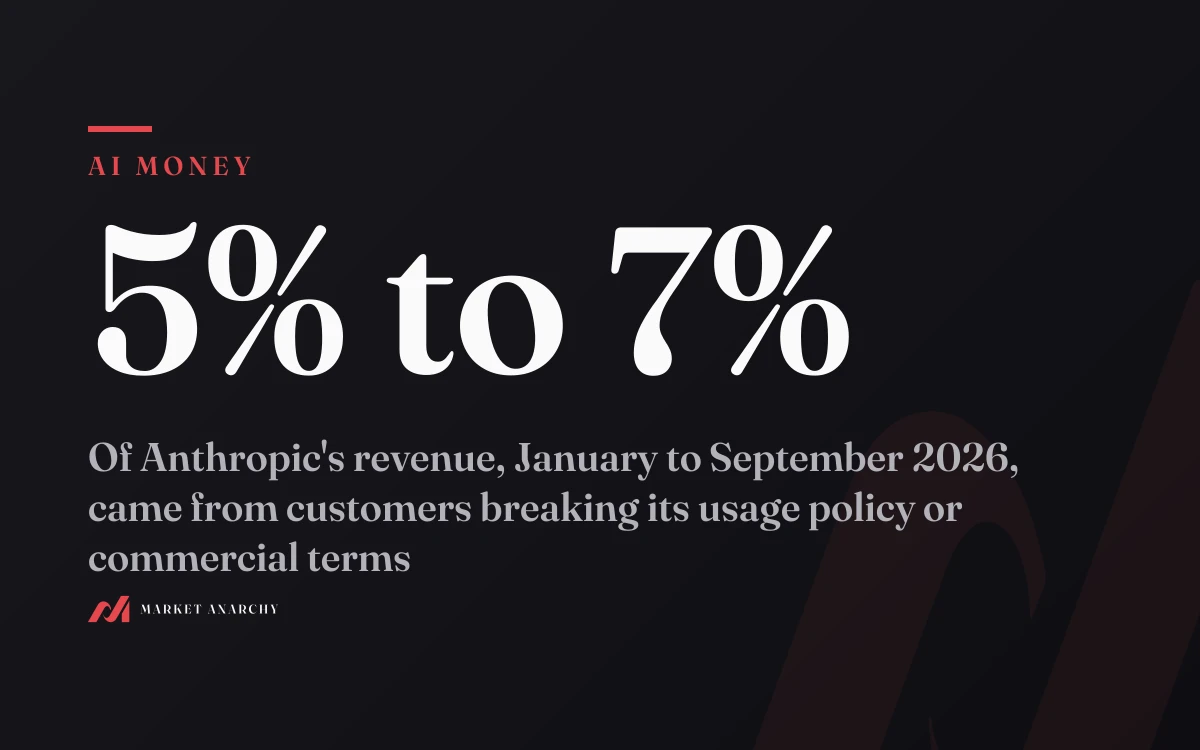
5% to 7%of Anthropic's revenue, January to September 2026, came from customers breaking its usage policy or commercial terms
$814M+the floor that share implies: 5% of first-half revenue alone
11.4Maccounts Anthropic banned from January to June 2026
10.6%of appeals Anthropic granted in the same six months: 42,000 of 398,000
Anthropic's IPO filing says roughly 5% to 7% of its revenue for the nine months ended September 30, 2026 came from customers it later found breaking its usage policy or its commercial terms. It expects that money to go away. The company says it stepped up detection and enforcement in August and September 2026, and that the share will fall in future periods.
The filing doesn't name those customers. Anthropic's own reports point at proxy services that resell Claude access and the fake accounts behind them.
If part of your income runs through Claude, the line is a question about how you pay for it. The odds after a ban are poor. From January to June 2026 Anthropic banned 11.4 million accounts, received 398,000 appeals and overturned 42,000, about one appeal in ten. Under its consumer terms, a subscriber cut off for a material breach gets no refund.
What the S-1 says about rule-breaking revenue
The disclosure sits in the management discussion of the S-1 filed on October 26, 2026. Anthropic books revenue from violating customers as it serves them, because "detection, investigation, and enforcement take time," and only then restricts or terminates them. It calls the pattern "common in our industry."
The filing leaves third-quarter revenue blank, so it never prints the dollar size of that 5% to 7%. The first half gives a floor. Revenue for the six months to June 30, 2026 was $16.286 billion: $13.064 billion from consumption, $3.222 billion from subscriptions. Five percent of the first half alone is about $814 million, and the nine-month total is larger.
Two more lines in the risk factors matter to anyone building on Claude:
- On limits: Anthropic has "changed, and may in the future change, usage limits, rate limits, or model and product capabilities," and some of those changes drew claims that its disclosures were "inadequate or misleading."
- On price: agentic products are "structurally more compute-intensive," and Anthropic may move to "outcome or task-based pricing."
That's the company's own text. The read that follows is ours.
Who the rule-breakers are
Anthropic has described two kinds in public this year.
The first is model copying. On February 23, 2026 it said DeepSeek, Moonshot and MiniMax ran about 24,000 fraudulent accounts and more than 16 million exchanges to train their own models on Claude's answers. They got in through "commercial proxy services which resell access to Claude." One proxy network ran over 20,000 accounts at once, "mixing distillation traffic with unrelated customer requests."
The second is fake discount access. Anthropic's September 2026 threat report describes a group it tracks as GTG-50021 that ran resellers selling cheap Claude access. Buyers' traffic went silently to a different model, and the group harvested their Anthropic credentials.
Those "unrelated customer requests" are paying customers of the proxy. Someone buying discounted Claude from a marketplace seller is sending work through the kind of account pool the S-1 says will shrink. When Anthropic shuts the pool, the buyer's access goes with it, and the buyer has no account of their own to appeal.
Three rules a freelancer can break without meaning to
The current documents name three things that small operators do every day.
Sharing one seat. The consumer terms say you may not share your login "or make your Account available to anyone else." A two-person studio working off one Max plan fits that sentence.
Piping a subscription into a tool. Anthropic's Claude Code legal page says subscription sign-in is for "ordinary use of Claude Code and other native Anthropic applications," and that third-party developers may not "route requests through Free, Pro, or Max plan credentials on behalf of their users." It adds that "advertised usage limits for Pro and Max plans assume ordinary, individual usage." Anthropic spelled this out in February 2026, and OpenCode removed subscription sign-in after what its commit called "anthropic legal requests."
Reselling access. The consumer terms bar using the service to "resell the Services." For products that run Claude Code, the legal page is blunter: customers "may not pay for, resell, or intermediate Claude usage on their end users' behalf."
None of the three clauses addresses selling work you made with your own seat. They cover who holds the access and who pays for it.
How to read the ban numbers
The 11.4 million figure counts accounts, and fraud farms open accounts by the thousand. One distillation campaign alone used 24,000. So the raw count overstates the risk to one honest subscriber by a wide margin.
The appeal figure is the one to keep. If your account goes, Anthropic granted 10.6% of appeals in the first half of 2026. The process runs through an in-product form with no stated timeline. A September 3, 2026 roundup collected reports from paying Max users banned with a template email citing "suspicious signals." Those cases are single-source and unverified. The 10.6% is Anthropic's own number.
What to change this week
- One seat per person. If two people use Claude for the business, pay for two.
- An API key for anything automated or client-facing. Scripts, agents and anything a client touches belong on a key from the Claude Console, billed to you. It costs more per heavy user than a flat plan. It also sits under terms written for that use.
- Skip discounted Claude from third parties. The September report shows what some of those offers were.
- Export on a schedule. A banned account takes its history with it. We covered the same exposure when an AI tool gets acquired: the window to get your data out is short.
- Keep a second model wired in. If one provider locks you out, your work should move to the other within the hour. Our piece on Cursor's Claude billing shows how fast plan terms around Claude can shift.
What to watch
The Transparency Hub was last updated on July 23, 2026. Its next update, covering July to December, will show whether the August and September push raised ban counts and whether the appeal rate held.
Anthropic's first quarterly reports as a public company will show whether the 5% to 7% falls as promised, and what it costs in growth. The same filing shows how much of Anthropic's compute is locked in; our read of its SpaceX deal covers that side.
The pricing line is the one that could reach every builder. A move to "outcome or task-based pricing" for agents would change the cost of any product priced on today's per-token rates.
Sources
- Anthropic, PBC, Form S-1, filed October 26, 2026 (SEC EDGAR)
- Anthropic Transparency Hub, banned accounts and appeals, updated July 23, 2026
- Anthropic, Consumer Terms of Service
- Claude Code docs, Legal and compliance
- Anthropic, Detecting and preventing distillation attacks, February 23, 2026
- Anthropic, Countering misuse of AI: September 2026
- The Register, Anthropic clarifies ban on third-party Claude access, February 20, 2026
- TokenKarma, Anthropic account bans hit paid Claude users, September 3, 2026
This is not financial advice.
More from AI money
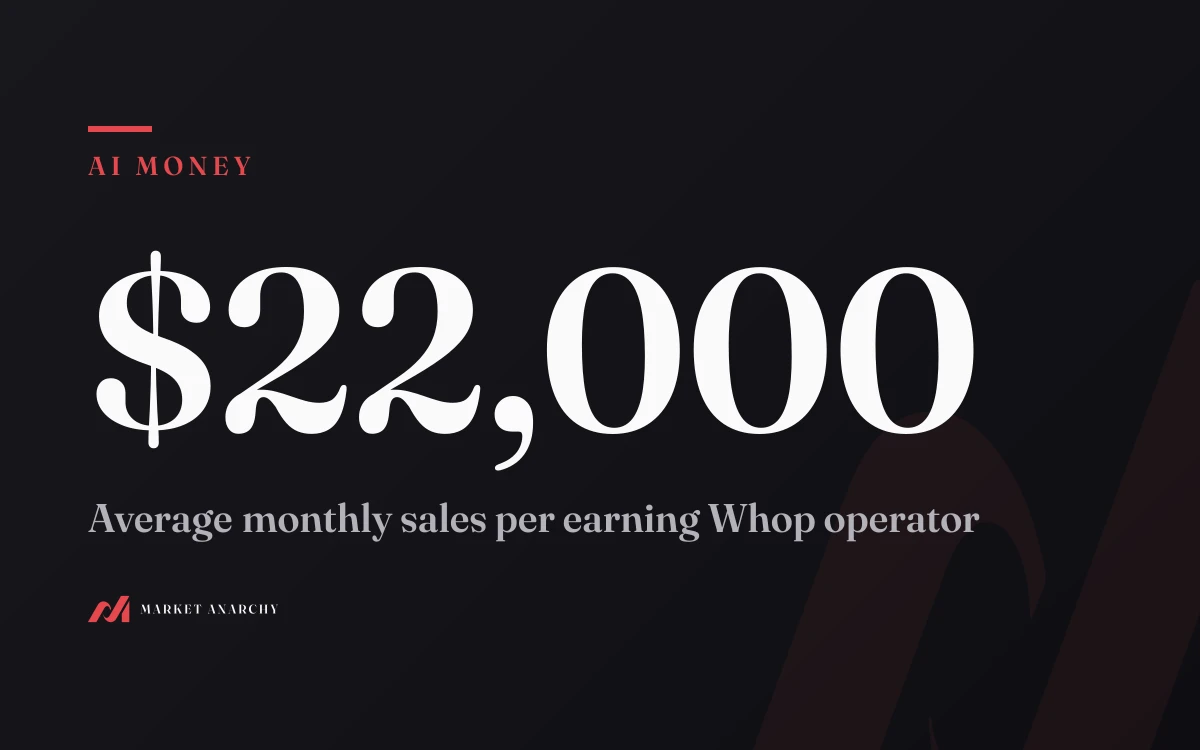
Whop sellers average $22,000 a month. Whop won't give the median.
Whop's 25,000 earning operators average $22,000 a month. Its AI Blueprints built 21,000 more businesses in six weeks and pay a copied seller 60 cents per $100.