
Brent fell 16% in a week. The CPI that shows it lands after the Fed.
Wholesale gasoline fell 11% last week, the pump about 3%. November CPI, where the drop shows, is out December 10, a day after the Fed votes on a hike.
By the numbers
16%Brent crude's fall in the week to November 6, its steepest since early 2020
11%drop in wholesale gasoline futures that week, against about 3% at the pump
76.8%odds of a December 9 Fed hike priced after Friday's jobs report
Dec. 10release of November's CPI, the first month to carry the cheaper gasoline
3.853%gasoline's weight in the consumer price index
Brent crude fell 16% in the week to November 6, from $117.64 to about $98.50 a barrel. Wholesale gasoline futures followed, down 11% to $2.77 a gallon. On the same Friday, a jobs report that beat every forecast pushed the odds of a Federal Reserve rate hike on December 9 to 76.8%.
Here is our read. The inflation the Fed is fighting is mostly gasoline, and gasoline just broke. The month that will show the drop in the official numbers is November, and BLS publishes November's consumer prices on December 10. That's the morning after the Fed decides. If the pump catches up with the wholesale price, the Fed will be raising rates into a CPI print that may show headline prices barely moving.
What oil did last week
Brent's 16% drop was its steepest weekly fall since the start of the Covid-19 pandemic, and its largest in dollar terms in LSEG data going back to 1988, Reuters reported. Oil lost 8% on Wednesday alone, after Democrats won both chambers of Congress and traders bet on a quicker end to the US-Israeli war with Iran.
No deal exists yet. Iran has sent a nuclear proposal through Qatar and wants the US naval blockade lifted before any full agreement. Attacks on ships in the Gulf haven't stopped: a seafarer was killed in a tanker explosion on November 5. Kpler's Matt Stanley put the week this way: "After over 25 years in this business, I honestly can't recall many weeks quite like this one."
The pump is a third of the way there
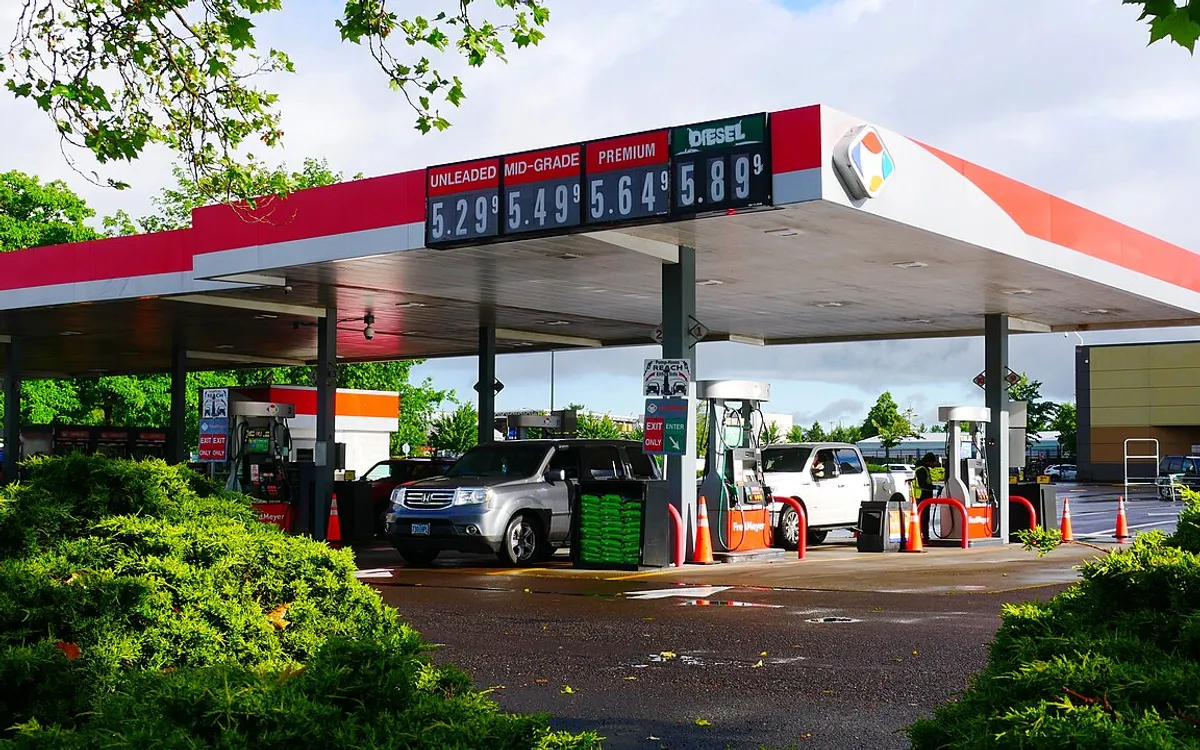
Wholesale gasoline fell 34 cents a gallon on the week, Mansfield Energy's tally shows. AAA's national average fell 12 cents, to $4.10, by November 5. Retail has passed on about a third of the move.
The gap is wide. At $4.10 retail and $2.77 wholesale, $1.33 sits between the futures price and the pump. Taxes take about 52 cents of it: 18.4 cents federal and an average of 33.55 cents in state taxes and fees, per the Energy Information Administration. That leaves roughly 81 cents for freight, distribution and station margins. For all of 2025, EIA put distribution and marketing at 16.6% of an average $3.10 gallon, about 51 cents. Futures are a New York Harbor price and every region pays its own premium on top, so treat the 81 cents as a rough gauge. It still says stations have room to cut, on the order of 30 cents.
OPIS's Tom Kloza said the average could approach $4 if the wholesale drop held, and put $3.90 to $3.95 on the table for Thanksgiving week if crude stabilizes. He added: "We've seen this movie before."
$2.81$4.35$4.31$4.15
View as table
| label | US regular gasoline, average retail price |
|---|---|
| January 2026 | $2.81 |
| September 2026 | $4.35 |
| October 2026 | $4.31 |
| Week of Nov. 2 | $4.15 |
What that does to November's CPI
Gasoline is 3.853% of the CPI basket. In September it rose 9.1% in a month and supplied over half of the 0.6% jump in all prices, BLS said. Headline inflation reached 3.7% over twelve months. Core prices, which leave out food and energy, rose 2.6%.
CPI counts the month's average price. EIA's weekly readings average $4.35 for September and $4.31 for October, a 1% decline. That's the gasoline in October's CPI, out Tuesday, November 10. November is where last week shows up.
Our arithmetic, at gasoline's 3.853% weight and against October's $4.31:
- Pump stays at $4.10 for November: a 4.9% drop, about 0.19 points off the month's headline CPI.
- Pump reaches Kloza's $3.95: an 8.4% drop, about 0.32 points off.
- Oil rebounds and the pump averages $4.25: a 1.4% drop, about 0.05 points off.
These are raw numbers. BLS seasonally adjusts gasoline, and the adjusted figure can land away from this arithmetic. The order of size holds. At $3.95, gasoline takes back nearly all of the roughly 0.35 points its 9.1% September jump added, by the same arithmetic.
Why the Fed may hike anyway
The case for December doesn't rest on gasoline alone, and it's worth stating fairly.
Payrolls rose 165,000 in October, against a forecast of 59,000, and August and September were revised up by a combined 84,000. Average hourly pay rose 0.4% in the month. Core CPI's twelve-month rate rose from 2.4% in August to 2.6% in September, above the Fed's 2% goal. The Fed already raised rates in September, then held at 3.75% to 4% on October 28 by 10 votes to 2, with Governor Lisa Cook and Cleveland Fed President Beth Hammack voting to hike. The statement said the Committee "will deliver price stability."
The Fed doesn't need CPI to see pump prices, either. EIA publishes them every Monday. And the oil drop was already on screens when futures priced the hike on Friday. Traders saw both and still bet on a hike.
There's also the oil risk. No deal is signed. US gasoline stocks sat 2% below their five-year average at the end of October, and winter refinery maintenance tightens supply further. A rebound to $105 Brent would wipe out most of the pump relief before November's average is set.
What to watch before December 9
- Tuesday, November 10: October CPI. Gasoline was down only 1% that month, so a firm core reading keeps the hike priced.
- Every Monday: EIA's retail gasoline price. A November average near $3.95 means a soft headline print on December 10.
- Fed speakers: Governor Christopher Waller on Tuesday and Hammack on Thursday, per CNBC. Hammack already voted to hike once.
- The two-year Treasury: it yielded 4.52% after the jobs report, pricing the hike in. If you hold cash, that's what our guide to T-bills versus savings accounts measures against.
We wrote in October that the pay squeeze was an energy bill. Last week the bill started shrinking. The Fed will decide on December 9 whether it believes that, a day before the data can say so.
Sources
- Reuters via RTÉ: Brent set for biggest weekly drop since 2020, November 6, 2026
- FinanceFeeds: Brent week ahead, November 7, 2026
- Mansfield Energy: Week in review, November 6, 2026
- AAA gas prices news, November 5, 2026
- Travelers Today: gas prices ahead of Thanksgiving, November 5, 2026
- EIA: factors affecting gasoline prices
- EIA: weekly US regular gasoline retail prices
- BLS: Consumer Price Index, September 2026, released October 14
- BLS: CPI release schedule 2026
- BLS: Employment Situation, October 2026, released November 6
- Federal Reserve: FOMC statement, October 28, 2026
- InvestmentNews: October jobs report lifts December hike odds, November 6, 2026
- Trading Economics: gasoline hits 8-month low, November 5, 2026
- CNBC: the week ahead, November 8, 2026
This is not financial advice.
More from Markets
I bond rates November 2026: what new and older bonds earn
New I bonds pay 5.51% until April 2027, with a 1.40% fixed rate. Older bonds earn their own fixed rate plus 4.08%. The table for every issue date.