T-bills or a savings account in 2026: what cash earns after tax
A 26-week Treasury bill yields 4.35%, Ally's savings 3.1% and the average savings account 0.37%. What each keeps after state tax, and when to pick which.
By the numbers
4.35%what a 26-week Treasury bill yields, October 16, 2026
3.1%Ally's online savings rate, the same day
0.37%the national average savings rate, FDIC, September 2026
3.75% to 4%the Fed's target range since September 16, 2026
In October 2026 a Treasury bill pays more than a savings account, and the gap grows after state tax. On October 16 a 26-week bill yielded 4.35% and a 52-week bill 4.44%. The same day Ally paid 3.1% on its online savings account, and the average US savings account paid 0.37% in the FDIC's September survey. Interest on a bill is free of state and local income tax, and interest on a savings account isn't. What a savings account still buys you is cash on any day of the week, with no auction and no maturity date to plan around.
The Fed raised its target range to 3.75% to 4% on September 16, the first increase since July 2023, and meets again on October 27 and 28. Every rate below is dated, because bills reprice every week and banks change theirs when they choose.
What cash pays in October 2026
| Where | Rate | Date | Source |
|---|---|---|---|
| 4-week Treasury bill | 4.02% | October 16, 2026 | US Treasury, daily bill rates |
| 13-week Treasury bill | 4.18% | October 16, 2026 | US Treasury, same table |
| 26-week Treasury bill | 4.35% | October 16, 2026 | US Treasury, same table |
| 52-week Treasury bill | 4.44% | October 16, 2026 | US Treasury, same table |
| Ally online savings | 3.1% APY | October 16, 2026 | Ally Bank |
| Average savings account | 0.37% | September 21, 2026 | FDIC, national rates |
| Average money market account | 0.63% | September 21, 2026 | FDIC, same page |
| Average 12-month CD | 1.73% | September 21, 2026 | FDIC, same page |
The Treasury publishes each bill's yield two ways. The bank discount rate runs lower; the coupon equivalent, used in the table, is the one to set against a savings account's APY.
On $25,000 for a year, before federal tax, which takes the same share of each: a 52-week bill at 4.44% earns about $1,110, Ally at 3.1% about $775, a 12-month CD at the national average about $432, and the average savings account about $92.
After state tax
"Interest on U.S. obligations is subject to federal income tax but exempt from state and local income taxes" (IRS Publication 550). A savings account's interest pays both. So the higher your state's rate on interest, the more a savings account has to pay to keep up with a bill:
| Your state's tax rate on interest | Savings rate needed to match a 13-week bill at 4.18% | Ally's 3.1%, after state tax |
|---|---|---|
| 0% | 4.18% | 3.10% |
| 5% | 4.40% | 2.94% |
| 10% | 4.64% | 2.79% |
The arithmetic is ours: the bill's yield divided by one minus the state rate. In a state with no income tax the comparison is the plain rates; at 10%, the same $25,000 at Ally keeps about $698 of its $775, while the 52-week bill keeps all $1,110 from the state.
What a bill is, and how you buy one
A Treasury bill is a loan to the US government for 4, 6, 8, 13, 17, 26 or 52 weeks. "Bills are sold at a discount or at par (face value). When the bill matures, you are paid its face value," and you can buy from $100 in steps of $100 (TreasuryDirect, Treasury bills). You can buy them in a TreasuryDirect account or through a bank or broker.
The interest is the gap between what you paid and the face value, and the IRS taxes it in the year the bill matures or is sold, whichever comes first (Publication 550). A 26-week bill bought this October matures next April, so its interest lands on your 2027 return.
Two things a bill asks of you. You choose a term, and when it ends you buy another at whatever the next auction pays. And if you need the money before the bill matures, you sell it at the market's price on the day, which can sit above or below what you paid.
Where a savings account still wins
Money you may need on any day. A savings account pays out the same afternoon at the same value. An emergency fund kept there gives up some yield to stay one transfer away.
Insurance you don't have to think about. Deposits are covered up to "$250,000 per depositor, per FDIC-insured bank, per ownership category" (FDIC). A bill is a debt of the US Treasury itself.
Not every savings account. The FDIC's average is 0.37% while Ally pays 3.1%. At the average rate, the account loses to everything else on this page, a 12-month CD included. We looked at what that gap could mean for banks in the piece on Apollo's agentic bank run warning.
If the Fed moves on October 28
The Fed raised rates on September 16 and meets again on October 27 and 28, then on December 8 and 9 (Federal Reserve, FOMC calendar; September statement). Bills reprice at every weekly auction, so a move shows up in the next ones you buy. A savings rate moves when the bank decides to move it. The average account paid 0.37% in the FDIC's September survey, against a Fed range of 3.5% to 3.75% before the hike and 3.75% to 4% after it.
For money you won't touch for a year, the question is the I bond as well: its rate resets on November 1, which we set out in our I bond and TIPS piece.
What changed
- October 18, 2026. First published, with the Treasury's bill rates and Ally's rate of October 16, the FDIC's national rates of September 21 and the Fed's decision of September 16.
Sources
- US Treasury, Daily Treasury bill rates, October 2026 (October 16, 2026)
- Ally Bank, Online savings account (rate as of October 16, 2026)
- FDIC, National rates and rate caps (September 21, 2026)
- FDIC, Deposit insurance FAQs
- Internal Revenue Service, Publication 550, Investment Income and Expenses (2025)
- TreasuryDirect, Treasury bills
- Federal Reserve, FOMC statement (September 16, 2026)
- Federal Reserve, Meeting calendars
This is not financial advice.
More from Markets
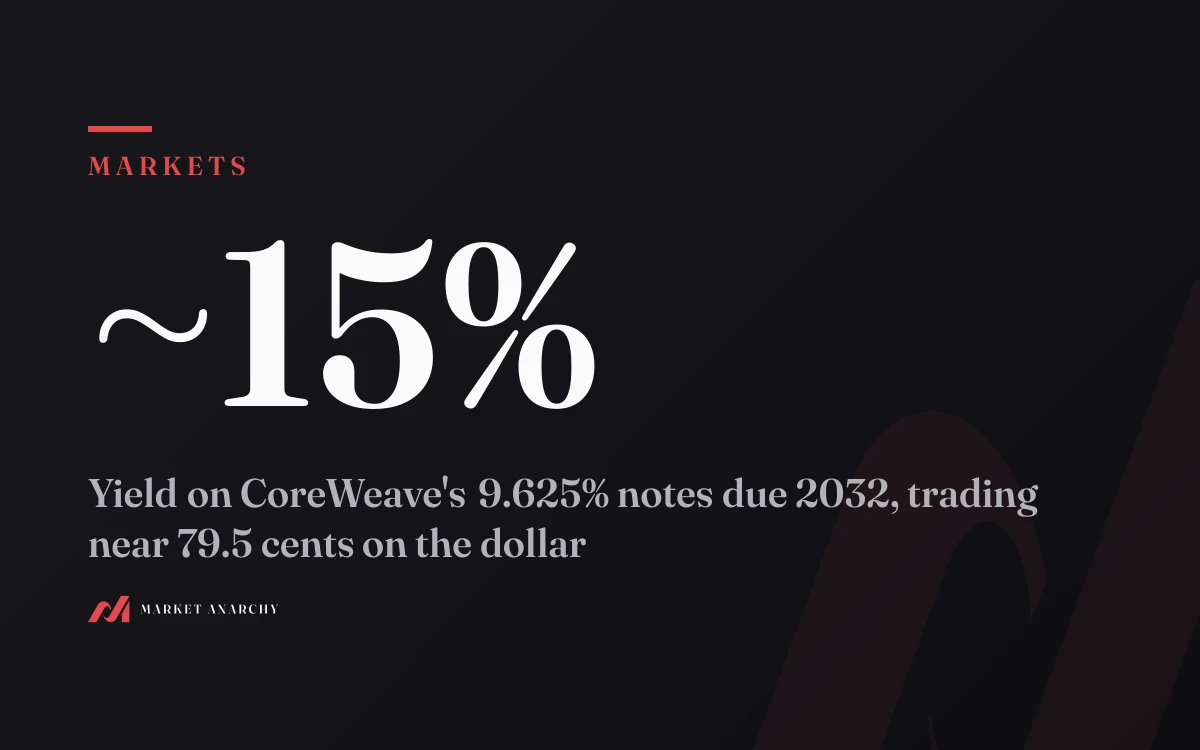
CoreWeave's debt yields 15%. Its income pays a quarter of the interest.
CoreWeave's 2032 bonds fell to 79.5 cents. Its own guide puts Q3 operating income at $200M to $260M against up to $940M of interest. Here is the gap in numbers.