CoreWeave's debt yields 15%. Its income pays a quarter of the interest.
CoreWeave's 2032 bonds fell to 79.5 cents. Its own guide puts Q3 operating income at $200M to $260M against up to $940M of interest. Here is the gap in numbers.
By the numbers
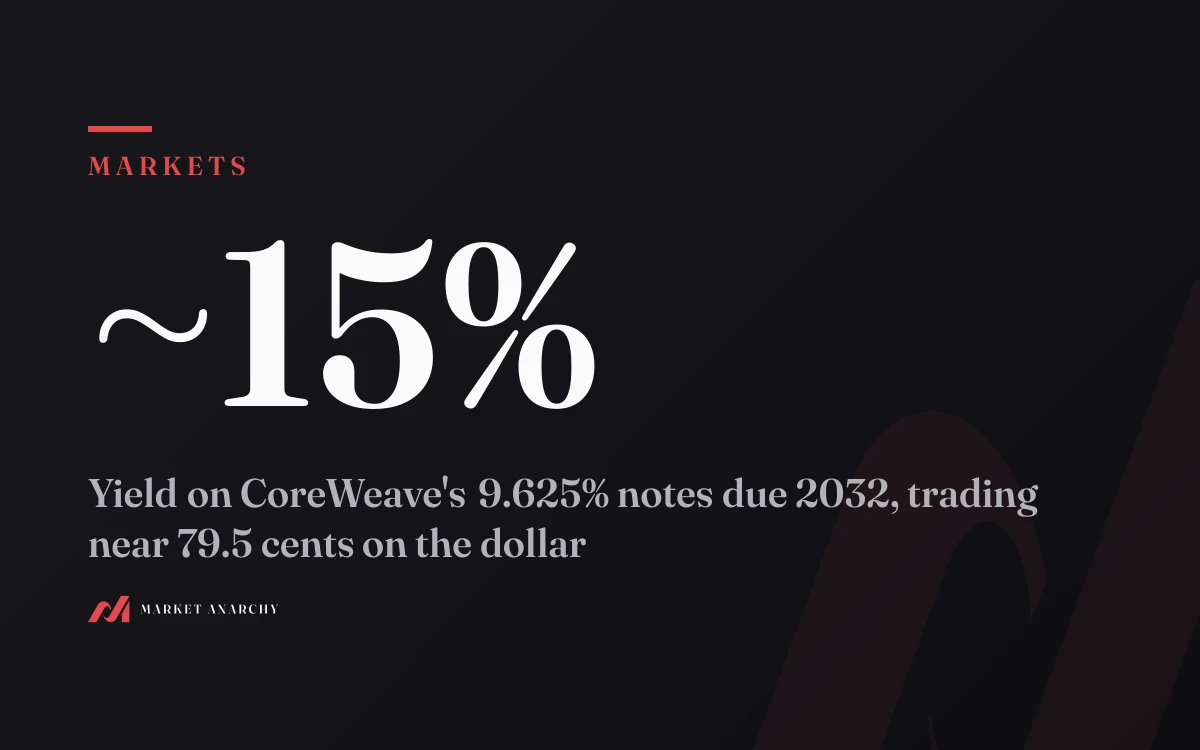
~15%yield on CoreWeave's 9.625% notes due 2032, trading near 79.5 cents on the dollar
$200-260MCoreWeave's guided third-quarter adjusted operating income
$860-940MCoreWeave's guided third-quarter interest expense
0.97 ptshow much the single-B junk index yield rose over the same four months
643 bpsCoreWeave five-year credit default swap spread, up from 368 on October 6
CoreWeave's unsecured bonds due 2032 traded below 80 cents on the dollar on October 14, 2026, a yield near 15%, four months after the company sold $1.25 billion of them with a 9.625% coupon. Chief executive Mike Intrator told staff the market was acting irrationally and that the $104 billion contract backlog more than covers the debt.
That comparison sets revenue against principal. Bondholders get paid from what is left after the company runs the machines, and CoreWeave's own guidance puts that number far below the interest bill. For the third quarter it guided adjusted operating income of $200 million to $260 million against interest expense of $860 million to $940 million. Every dollar of interest is matched by 21 to 30 cents of operating income. The bond market has read that line, and it is pricing the notes much closer to the riskiest tier of junk than to the B+ rating they carry.
What the bond price says, in numbers
A 9.625% coupon bond due July 2032 that trades at 79.5 cents yields about 14.9% to maturity (our calculation, semiannual coupons, about 5.75 years left). That matches the 14.8% to 15% reported for the notes the same week. A buyer from June has lost about 20 cents on every dollar lent.
The insurance market moved with it. CoreWeave's five-year credit default swaps rose from 368 basis points on October 6 to 643, a level the same analysis translates into roughly a 35% chance of default within five years. That probability is an estimate built on an assumed recovery rate, so treat it as a reading of the market's mood.
How much of the 15% is CoreWeave
Rates went up for everyone since June, so part of the move is the market. The split is easy to measure.
- The 10-year Treasury yield went from 4.45% on June 11 to 5.10% on October 15, up 0.65 points.
- The ICE BofA single-B high yield index, the bucket a B+ issuer sits in, went from 7.15% to 8.12%, up 0.97 points.
- CoreWeave's 2032 notes went from a 9.625% coupon to about 14.9%, up roughly 5.3 points.
So about one point of the move is what every single-B borrower suffered. The other four-plus points are a verdict on CoreWeave alone.
6.84%8.12%14.8%17.5%
View as table
| label | Junk bond yields, mid-October 2026 |
|---|---|
| BB index | 6.84% |
| Single-B index | 8.12% |
| CoreWeave 9.625% 2032 | 14.8% |
| CCC and lower index | 17.5% |
At 14.8%, CoreWeave sits 6.7 points above its rating bucket and 2.7 points below the CCC and lower index at 17.50%. The rating says single-B. The price says nearly CCC.
Why the backlog does not settle it
Intrator's math is real on its face. CoreWeave reported a revenue backlog of about $104 billion on June 30, 2026, against $35.1 billion of debt ($31.4 billion recourse, $3.7 billion non-recourse). That's three dollars of contracts for each dollar borrowed.
Three things stand between that backlog and a bondholder.
The costs of delivering it. Backlog is revenue still to be earned, and earning it means paying for power, data center space and the GPUs that wear out. The same balance sheet carries $16.3 billion of operating lease liabilities, mostly data center rent, which takes debt and debt-like obligations to about $51 billion. Against that total the backlog cover falls to about two times.
The spending still ahead. CoreWeave guided 2026 capital spending of $35 billion to $39 billion on revenue of $12.4 billion to $13.2 billion. Each dollar of this year's revenue comes with nearly three dollars of new equipment, much of it bought with more borrowing. The backlog funds the build. It does not free cash for the old lenders until the build stops.
The calendar. About $6.2 billion of debt falls due in 2027 and $4.4 billion more before the end of 2026, against $5.5 billion of cash on June 30. Those maturities get refinanced in the market that this week marked the 2032 notes down 20 points.
The case for the company
The bear reading leans on one profit line, and there is a fair objection to it. In the second quarter CoreWeave posted adjusted EBITDA of $1.51 billion against $640 million of interest, 2.4 times cover. EBITDA leaves out depreciation, which is most of the gap between the two lines for a company that buys GPUs by the billion. If the GPUs earn for longer than their accounting life, the operating income line understates the cash.
Customers also pay ahead. The company expects more than $9 billion of customer prepayments in 2026, which is money it does not have to borrow.
Our read: both cases rest on the same unknown, how long an AI chip earns rent. EBITDA bulls assume a long life. Operating income assumes the accounting one. The bonds are priced for something shorter. We covered the rent side of that question when H100 rental prices moved, and the lender side when Broadcom started financing its own customers.
Who this touches
If you own an S&P 500 or Nasdaq index fund, you own the suppliers whose sales depend on borrowers like CoreWeave. Semiconductor stocks fell for eight straight sessions through October 16, their longest losing streak since 2008, and the Nasdaq Composite lost more than 4% on the week.
If you own a high yield bond fund, check its holdings for AI data center issuers. A 15% yield pays well only if the coupons keep coming.
What to watch
- Third-quarter results. The test is whether adjusted operating income lands inside the $200 million to $260 million guide and whether interest stays under $940 million.
- The next debt sale. Any new CoreWeave issue will price near where the 2032 notes trade, around 15%. A sale at that level raises the interest bill the operating line already fails to cover.
- The CDS spread. A move back under 400 basis points would mean the market accepts the backlog argument. A move toward 1,000 would mean it doesn't.
Sources
- Yahoo Finance / TheStreet: CoreWeave CEO responds as worry over spending bill comes due
- Business Wire: CoreWeave prices $1.25 billion and €2 billion of senior notes, June 11, 2026
- investingLive: CoreWeave bonds trade like distressed debt
- CoreWeave Q2 2026 outlook presentation, August 11, 2026
- CoreWeave second quarter 2026 results
- Real Investment Advice: CoreWeave shares tumble as its debt flounders
- FRED: 10-year Treasury constant maturity (DGS10)
- FRED: ICE BofA single-B US high yield effective yield
- FRED: ICE BofA CCC and lower US high yield effective yield
- Yahoo Finance: CoreWeave's $35-$39B capex plan
- FinancialJuice: tech selloff deepens as AI financing concerns weigh on stocks
- TheStreet: stock market today, October 16, 2026
This is not financial advice.
More from Markets
T-bills or a savings account in 2026: what cash earns after tax
A 26-week Treasury bill yields 4.35%, Ally's savings 3.1% and the average savings account 0.37%. What each keeps after state tax, and when to pick which.