Broadcom's CEO says capital limits AI. Broadcom lends $42B of it.
Hock Tan called AI investors gamblers. Broadcom backs $42B of Anthropic's chip debt and is lining up $50B for OpenAI, more than Lucent lent at its 2000 peak.
By the numbers
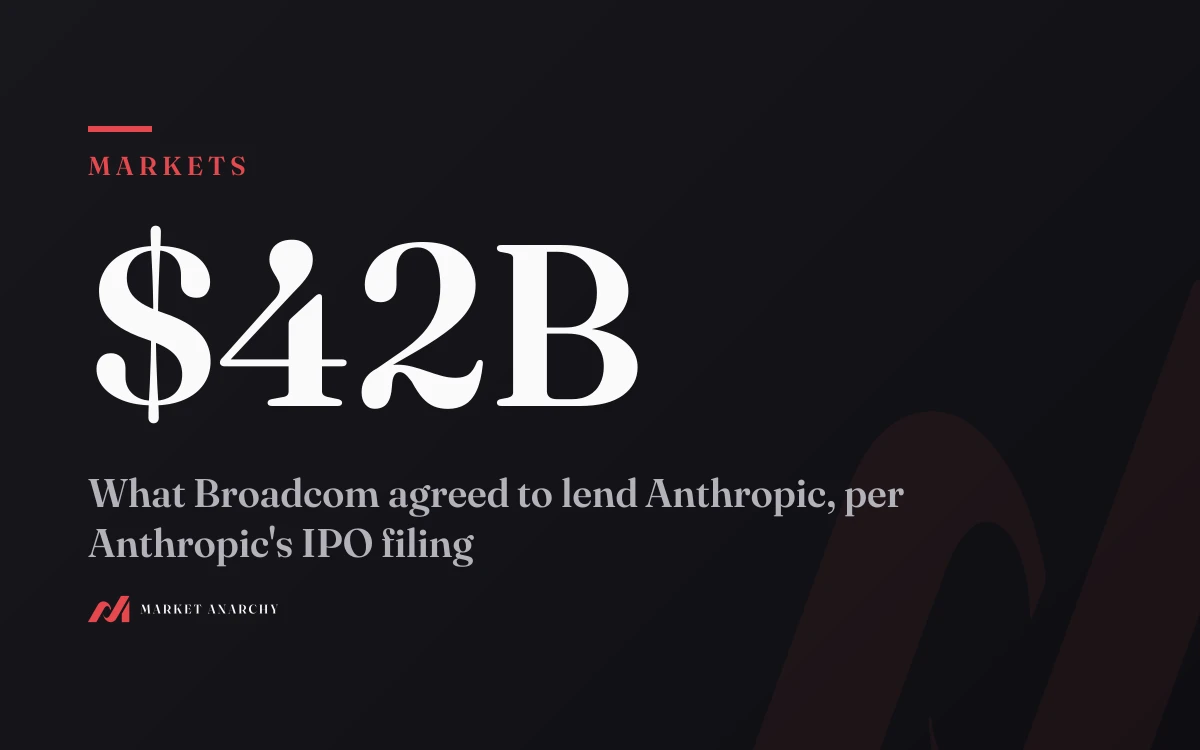
$42Bwhat Broadcom agreed to lend Anthropic, per Anthropic's IPO filing
$50B+the financing Broadcom is arranging for OpenAI's chips
$24.0BBroadcom's cash on August 2, 2026
78%both deals as a share of Broadcom's annual revenue pace
24%Lucent's customer financing as a share of its revenue in 2000
On Monday, October 12, Broadcom CEO Hock Tan told a conference in Singapore that "a lot of investors have no clue what they are investing in" and that the biggest constraint on AI growth "might be capital" (The Next Web, October 13, 2026). Both lines hold up. They also describe Broadcom's own business. In the two weeks before he spoke, Anthropic's IPO filing showed Broadcom agreeing to lend it up to $42 billion to lease Broadcom-designed chips, and the Wall Street Journal reported Broadcom arranging more than $50 billion so OpenAI can buy its custom chips.
Add the two and you get $92 billion. That's about 78% of Broadcom's revenue at its latest quarterly pace. Lucent, the textbook case of a supplier financing its own buyers, had about $8.1 billion of customer credit and guarantees out in September 2000: 24% of that year's revenue. Broadcom's borrowers are far stronger than Lucent's were. Measured against what it sells, its exposure is bigger.
Our read: the capital shortage Tan named is being filled partly by Broadcom's balance sheet. So some of the bet he compared to a casino sits with Broadcom shareholders, and every S&P 500 index fund is one of them.
What Hock Tan said on October 12
Tan spoke on a panel at the DBS Asia Future Forward Conference alongside Intel CEO Lip-Bu Tan. He said investors "set very extreme expectations only to find out that it's almost like they are in a casino", that companies are "wasting money, spending tokens, trying to understand" AI, and that capital, more than chips, is the constraint to watch (The Next Web, October 13, 2026; Bloomberg, October 12, 2026).
Chip stocks took it badly the next day. On October 13, Micron fell more than 3% and the Roundhill Memory ETF slid more than 3%, with traders pointing to Tan's comments and to competition from China (Motley Fool, October 13, 2026).
What Broadcom agreed to lend Anthropic
Reuters read the terms in Anthropic's IPO prospectus on October 1. Broadcom agreed to lend up to $42 billion, in notes that could convert into Anthropic shares. The money covers about a third of Anthropic's $125.2 billion, five-year lease of TPU computing capacity (Reuters via Investing.com, October 1, 2026).
Three details in that filing matter more than the headline number:
- Anthropic put cash into a restricted account for Broadcom's benefit in April 2026 and "may be required to contribute additional amounts".
- Certain payment defaults could make a large part of the lease obligations due at once, while limiting Anthropic's access to the $42 billion facility.
- Anthropic itself flagged "potential conflicts of interest", because Broadcom is its chip supplier, its lessor and its lender at the same time.
A day later Bloomberg described the wider package: $60 billion, with $42 billion of senior secured debt marketed by a bank syndicate and an $18 billion junior tranche led by Blackstone, which committed $9 billion of its own money (American Bazaar, citing Bloomberg, October 2, 2026). The senior debt is backed by Broadcom guarantees and the residual value of the chips. The junior tranche carries no Broadcom guarantee (Motley Fool, October 13, 2026).
The reports describe Broadcom's role two ways: lender in the Reuters account, guarantor of a syndicated loan in Bloomberg's. The prospectus is still confidential on EDGAR, so we can't settle it from the primary document. Either way, if Anthropic stops paying, the loss on the senior $42 billion comes back to Broadcom.
The OpenAI deal is still talks
The Journal reported on October 7 that Broadcom is arranging more than $50 billion of financing for the custom chips it is building with OpenAI, and that it has approached Apollo and Blackstone. The talks are early and the size could change; none of the companies commented (investingLive, citing the WSJ, October 8, 2026). Nobody has reported yet whether Broadcom would guarantee any of it.
Treat the $50 billion as a projection. The $42 billion is signed.
Sizing it against Broadcom's own books
Broadcom's fiscal third quarter ended August 2, 2026. It reported $29.6 billion of revenue, $13.7 billion of free cash flow, $24.0 billion of cash and $59.4 billion of total debt (Broadcom 8-K, September 2, 2026).
On those numbers, the Anthropic facility alone is 1.75 times Broadcom's cash and about three quarters of its free cash flow. The arithmetic below is ours, with revenue annualised from that quarter ($118.4 billion) and Lucent's figures from its fiscal 2000 annual report.
24%35.5%77.7%
View as table
| label | Customer financing as a share of the supplier's annual revenue |
|---|---|
| Lucent, September 2000 | 24% |
| Broadcom, Anthropic facility | 35.5% |
| Broadcom, Anthropic plus OpenAI talks | 77.7% |
The Lucent comparison, and where it breaks
Lucent's fiscal 2000 annual report shows $6.7 billion of commitments to extend credit to customers, of which $1.3 billion had been drawn, plus $1.4 billion of guarantees on customers' debt. Revenue that year was $33.8 billion. The filing also says Lucent intended to sell those loans on to financial institutions and other investors, which is what Broadcom's bank syndicate and Blackstone tranche do today.
The comparison breaks on the borrower. Lucent lent to young telecom carriers with thin revenue. Anthropic reported $11.5 billion of revenue in the second quarter of 2026 alone, against $4.6 billion for all of 2025, and $20.28 billion of cash, according to reporting on the prospectus (24/7 Wall St. via Yahoo Finance, September 30, 2026). Those figures come from a filing that isn't public yet, so treat them as reported, not audited.
A borrower growing that fast can carry a lot of debt. The risk sits in the commitments: Anthropic's computing obligations run to $518 billion over about ten years, by the same report. The $42 billion is one slice of that.
Why the chips are weaker collateral than they look
The senior lenders hold the residual value of the chips as security. Custom accelerators are designed around one customer's models and one data center layout. An Nvidia GPU can be rented to almost anyone, and even those lose value fast when supply catches up: an H100 now rents for $4.50 an hour. A custom chip has fewer second buyers. That's our analysis, and it means the collateral is worth most while the borrower is healthy, which is when nobody needs it.
Who carries the risk
Broadcom shareholders carry the guarantee. Blackstone's investors carry the unguaranteed $18 billion. Anthropic's future public shareholders carry the restricted cash and the acceleration clause. The pattern matches what we found when Nvidia's supply commitments hit $279 billion: the AI buildout keeps moving risk from the labs onto the balance sheets of the companies selling to them.
If you own an S&P 500 fund, you hold Broadcom, and you sat through the last round of this when chips shed $1.5 trillion in three weeks. You didn't choose to lend to Anthropic. Through the guarantee, part of your fund did.
None of this means Broadcom is wrong to lend. Financing demand it can see is a rational way to win a customer that could become its largest next year. It does mean the casino Tan described has a house, and Broadcom is partly playing it.
What to watch
- Anthropic's public prospectus. It has to go public before the roadshow. It will show whether Broadcom is lender, guarantor or both, and on what terms.
- The OpenAI terms. Whether the $50 billion carries a Broadcom guarantee decides whether the 78% figure is exposure or just facilitation.
- Broadcom's fiscal fourth quarter, due in December. It guided to $34.8 billion of revenue and $21.7 billion of AI chip revenue (Broadcom 8-K). Watch for any new line on guarantees or customer financing.
Sources
- The Next Web: Broadcom's Hock Tan likens many AI investors to casino gamblers, October 13, 2026
- Bloomberg: Broadcom CEO likens many AI investors to casino gamblers, October 12, 2026
- Motley Fool: Stock market today, October 13, 2026
- Reuters via Investing.com: Broadcom to lend Anthropic up to $42 billion, October 1, 2026
- American Bazaar, citing Bloomberg: Broadcom lines up $60 billion financing package, October 2, 2026
- Motley Fool: Broadcom is backing Anthropic and OpenAI with $92 billion, October 13, 2026
- investingLive, citing the WSJ: Broadcom seeks over $50 billion for OpenAI chips, October 8, 2026
- Broadcom Form 8-K, fiscal Q3 2026 results, September 2, 2026
- Lucent Technologies Form 10-K405, fiscal year ended September 30, 2000
- 24/7 Wall St. via Yahoo Finance: Anthropic's prospectus shows a giant loss and an even bigger ask, September 30, 2026
This is not financial advice.
More from Markets
T-bills or a savings account in 2026: what cash earns after tax
A 26-week Treasury bill yields 4.35%, Ally's savings 3.1% and the average savings account 0.37%. What each keeps after state tax, and when to pick which.