Auto rollovers cut 401(k) cash-outs to 9%. 94% are still parked.
Automatic 401(k) rollovers cut small-balance cash-outs from 50% to 9%. Then 94% of the money sits in interim IRAs paying fees. How to move yours.
By the numbers
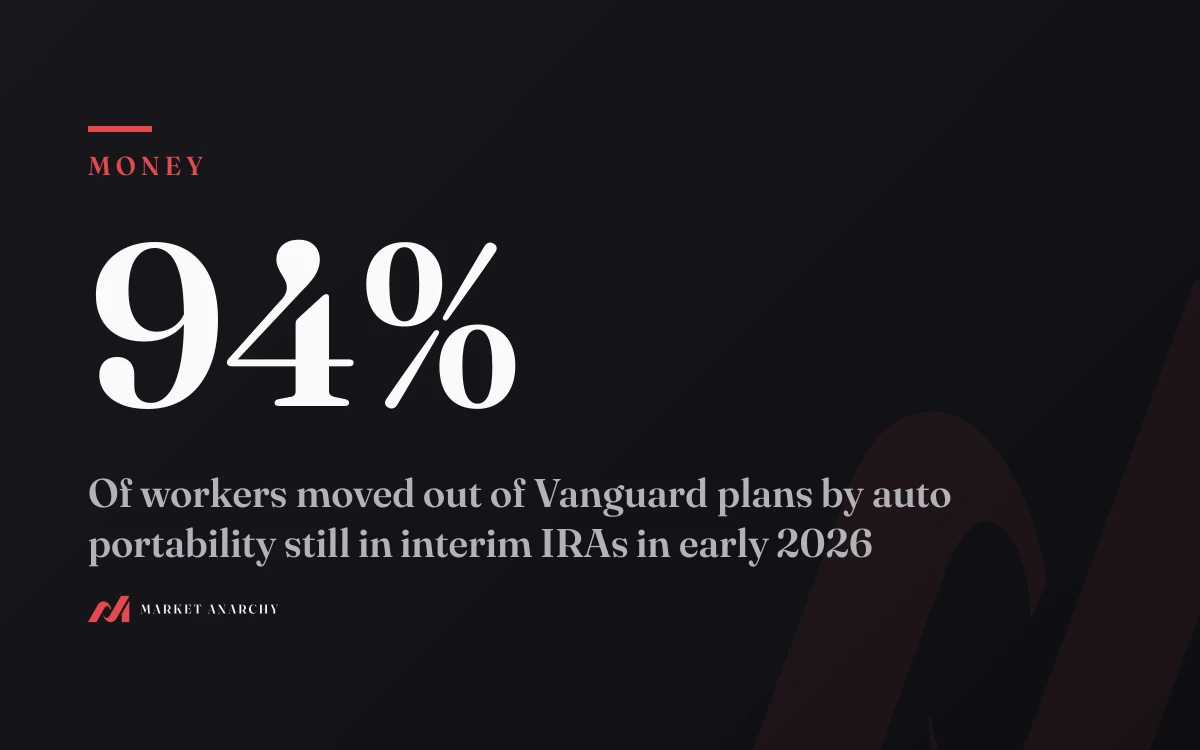
94%of workers moved out of Vanguard plans by auto portability still in interim IRAs in early 2026
9%cash-out rate on balances under $1,000 after plans joined, down from 50%
$200median balance the network rolled out of Vanguard plans
5%one-time transfer fee on balances under $600, capped at $30 above that
1.22 millionworkers waiting to be matched to a new employer's plan
Automatic 401(k) rollovers do the first half of their job well. When an employer's plan joins the Portability Services Network, workers who leave with less than $1,000 mostly stop cashing out: 9% took cash within 10 months of leaving, against 50% before the plan joined, Vanguard found across 83 of the plans it runs.
The second half, landing that money in the worker's next 401(k), has barely started. About 6% of the workers whose accounts the network moved out of Vanguard plans had been matched to a new employer's plan by early 2026. The other 94% were sitting in interim IRAs, in investments built to protect principal, paying account fees while they wait.
If you changed jobs in the last two years and left less than $7,000 behind, some of your savings may be in one of those IRAs. You don't have to wait for the network to find your new plan. You can move the money yourself, and on a small balance the sooner you do it, the less the fees take.
What Vanguard measured
The study, by Fiona Greig, Kelly Hahn and Fu Tan and published October 7, 2026, follows people who left 83 network plans that Vanguard keeps the records for, between January 2022 and December 2025, and watches each one for at least 10 months after they left.
The accounts are small. Vanguard counted about 220,000 rollovers out of its plans into the network's IRAs, with a median of $200 and nearly three in four under $1,000. The typical worker moved was 31, earned about $20,000 a year and had stayed six months, CNBC reported on October 31.
For balances under $1,000 the change is large: 50% cashed out before, 9% after. For balances between $1,000 and $7,000 it is smaller, 39% before and 31% after. Vanguard's own summary calls that band "similar before and after," at 30% to 40%. Read the second figure as a modest effect.
Why the money stops halfway
The network moves a small balance in two steps. First, the old employer forces it out of the plan into a "safe harbor" IRA, which plans may do for balances under $7,000 since SECURE 2.0 raised the limit from $5,000. Then, when the worker shows up in another plan that belongs to the network, the IRA rolls into that plan on its own.
Step two needs both employers in the network, and few are. About 3% of US 401(k) plans participate, Vanguard reports. The network counts 23,787 plans covering 7.73 million people, and 1.22 million workers waiting for a match, up 25% since early 2026, per CNBC.
The trips that do finish are few. Since its November 2023 launch the network has completed 53,118 transactions worth $71.3 million. That works out to about $1,342 each, our division of the network's figures. It is a different population from Vanguard's $200 median, so the two can't be compared directly, but the scale is clear: 1.22 million workers waiting, against 53,118 finished transfers in three years.
What a $200 account pays while it waits
The moves cost money, and the costs are flat, so they bite hardest on the smallest accounts.
- The transfer. The network charges a one-time fee when it moves an account into a new plan. Its FAQ sets the maximum at $30, charges 5% of the balance below $600, and moves accounts under $50 for free. On the median $200, that is $10.
- The wait. The interim IRA charges a recurring account fee. The network's public FAQ doesn't print the amount, so check your own IRA statement. The arithmetic is simple: every $1 a month of account fee takes 6% a year from a $200 balance.
- The investment. Safe harbor IRAs default to products designed to protect principal, which in practice means cash-like returns. For what cash earns at the moment, see our guide to T-bills and savings accounts.
None of this is new. In 2014 the Government Accountability Office looked at forced-transfer IRAs from 10 providers and found that "fees outpaced returns in most of the IRAs analyzed", so balances shrank over time. Vanguard's 2026 paper says the same thing more politely: in interim IRAs, "recurring account-level fees and conservative default investments may erode balances."
Our read: the network has turned a 50% cash-out problem into a parked-money problem. Parked money is better than spent money, because it is still in a tax-sheltered account. It isn't growing, though, and a flat fee on a $200 balance can take more in a year than the investment earns.
Roth money can't finish the trip
Roth 401(k) dollars that are forced out land in a Roth IRA, and a Roth IRA can't be rolled into a 401(k). Those small Roth balances can't move to a workplace plan at all, CNBC reported in March. If yours is Roth money, the only exit is another Roth IRA, which you open and fund yourself.
What to do if some of your money is parked
- Find it. The plan you left must tell you where it sent your balance; the notice names the IRA provider. If you lost the letter, the Labor Department's Retirement Savings Lost and Found, live since December 2024, searches by Social Security number.
- Pick a destination. If your current 401(k) accepts roll-ins, that consolidates everything in one place with its fees and funds. If it doesn't, or the money is Roth, a rollover IRA at a broker with no account fee stops the monthly charge.
- Ask the receiving side to pull it. A direct rollover, institution to institution, keeps the money sheltered. Check the interim IRA's statement for a closing or distribution fee first, so you know what the move costs.
- Don't cash it out. Before 59½, a cash distribution carries an additional 10% tax on top of income tax, unless you left that job in or after the year you turned 55.
What could change this picture
The study is early. It covers Vanguard's plans only, watches workers for as little as 10 months, and was written by the record keeper that helped found the network. The match rate rises if more employers join: a 3% membership caps how often step two can happen. Fees, the network says, are expected to fall as more record keepers join.
What would disprove our read is a higher match rate in the next count, or fee schedules low enough that a $200 balance keeps its value while it waits. Until then, the money is safest in an account you chose.
Sources
- Vanguard: The promise and limits of 401(k) auto portability, October 7, 2026
- CNBC: Automatic 401(k) rollovers reduce cash-outs, October 31, 2026
- TokenPost: Automatic portability linked to fewer small 401(k) cash-outs
- Portability Services Network: FAQs and fees
- Retirement Clearinghouse: Know the essentials about safe harbor IRAs
- GAO-15-73: Greater protections needed for forced transfers and inactive accounts, November 21, 2014
- CNBC: Small 401(k)s may follow workers to their next job, except Roth money, March 9, 2026
- US Department of Labor: Retirement Savings Lost and Found
- PlanAdviser: DOL's Retirement Savings Lost and Found database goes live
- IRS: Exceptions to tax on early distributions
This is not financial advice.
More from Money
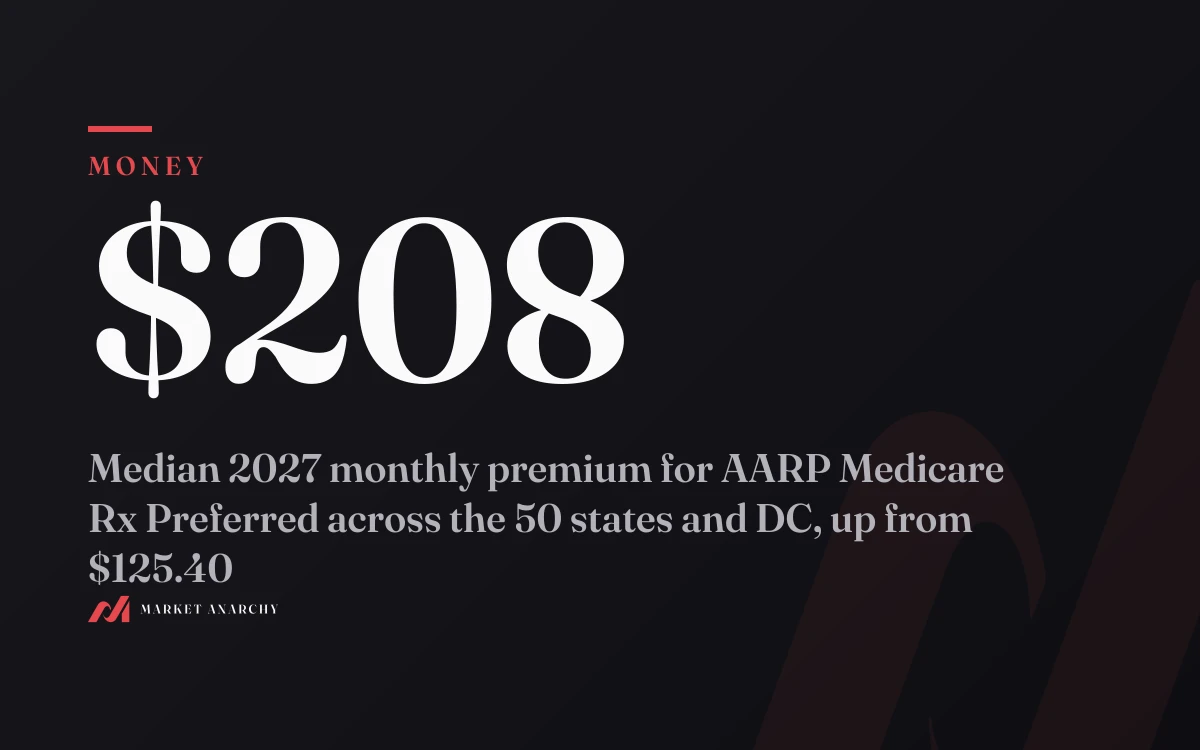
AARP Rx Preferred hits $208 a month. The drug cap is $2,400 a year.
AARP's top Medicare drug plan tops $200 a month in 33 states for 2027, more a year than the $2,400 drug cap. Rivals start at $5.30. Switch by December 7.