Card rates sit 18.7 points over the Fed. December's hike adds $17.
A December Fed hike adds $17 a year to an average card balance. The card's margin over the Fed costs $1,245, and it is the part you can cut this month.
By the numbers
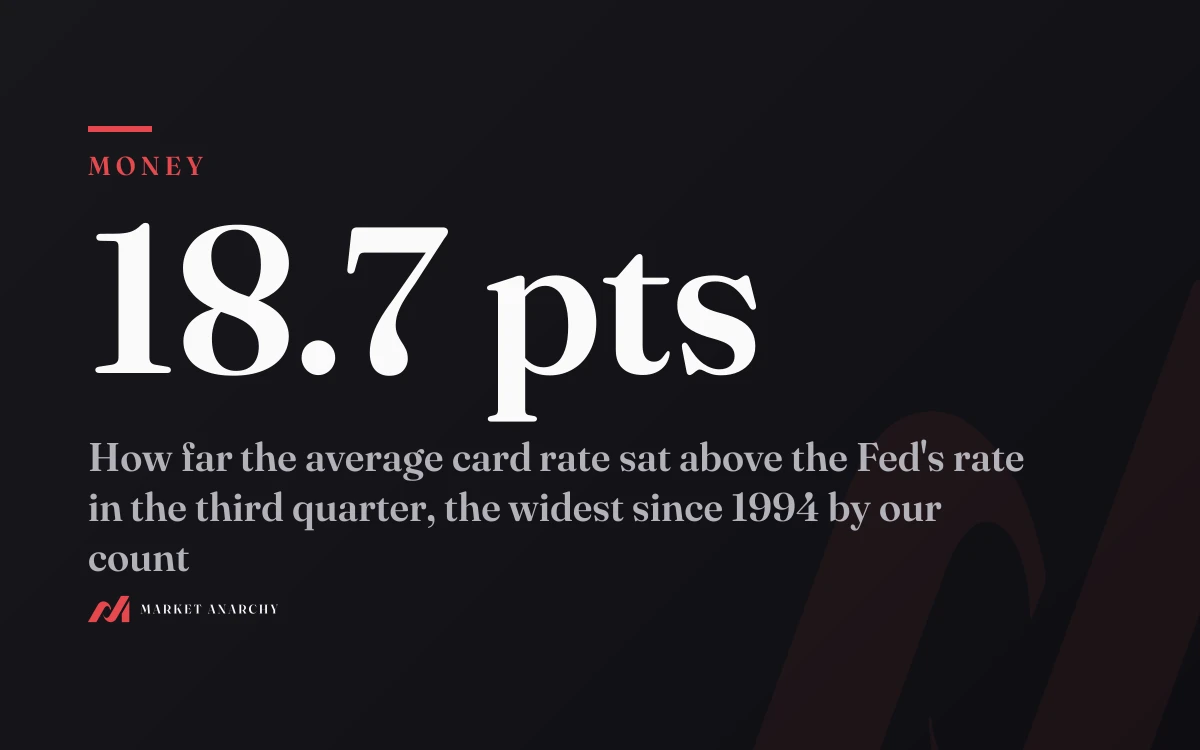
18.7 ptshow far the average card rate sat above the Fed's rate in the third quarter, the widest since 1994 by our count
22.36%average rate on card accounts charged interest, third quarter of 2026
$17what a quarter-point Fed hike adds in a year to a $6,659 balance
$1,245the share of that balance's yearly interest that is the card's margin over the Fed
If the Fed raises rates on December 9, a card balance of $6,659 will cost about $17 more a year. The same balance already costs about $1,489 a year at the average card rate, and roughly $1,245 of that has nothing to do with the Fed. It is the margin card issuers charge on top of the central bank's rate, and in the third quarter of 2026 that margin was 18.7 percentage points, the widest in the Fed's data going back to 1994, by our count.
So a December hike is a rounding error on a holiday balance. The number that decides what you pay is the card's own margin, and it is the one number you can change this month.
What cards charge right now
The Fed's consumer credit release of November 6 put the average rate on card accounts that were charged interest at 22.36% in the third quarter of 2026, up from 22.15% in the second quarter. Across all accounts, including people who pay in full, the average was 21.19%.
The Fed's own rate averaged 3.67% over the same three months, from the effective federal funds rate of 3.63% in July and August and 3.75% in September, after the Fed raised its range on September 17. Subtract one from the other and you get the 18.69 points in the spine above.
How wide is that? In the third quarter of 2006, with the Fed's rate at 5.25%, the average card rate on accounts charged interest was 14.67%. The gap was 9.4 points. It has roughly doubled in twenty years. The same quarterly arithmetic gives 18.54 points in the third quarter of 2025 and 18.52 in the second quarter of 2026, so the record has been set and reset within a year.
The CFPB found the same drift with a different yardstick. Measured against the prime rate, it put the average APR margin at 14.3% in 2023, up from 9.6% in 2013, and estimated the extra margin cost cardholders $25 billion that year. It found the margin rose despite lower charge-off rates and a steady share of subprime cardholders, so riskier borrowers do not explain it.
Why the Fed moves your rate one way faster than the other
Most card rates are written as prime plus a margin. Prime sits 3 points above the top of the Fed's range, and banks move it the day the Fed moves. When the Fed raised its range to 3.75% to 4% on September 17, the prime rate went from 6.75% to 7.00% the same day, and variable card rates follow within a statement or two.
The way down is slower. From the third quarter of 2025 to the third quarter of 2026, the effective federal funds rate fell 0.62 points, from 4.29% to 3.67%. The average rate on card accounts charged interest fell 0.47 points, from 22.83% to 22.36%. By that measure, about three quarters of the cut reached cardholders. The rest went into the margin.
December looks like the next step up. The Fed held at its October 28 meeting by a 10 to 2 vote, and both dissenters, Lisa Cook and Beth Hammack, wanted a quarter-point hike. Bond traders kept pricing one even through the November sell-off, as we covered when stocks fell 8.6% in a week. The committee meets December 8 and 9.
What a hike costs, and what the margin costs
Take Experian's average card balance of $6,659, measured in March 2026, and carry it for a year at the third-quarter average rate. These are our calculations, simple interest, before fees:
| Piece of the rate | Rate | Yearly cost on $6,659 |
|---|---|---|
| The Fed's rate, Q3 2026 average | 3.67% | $244 |
| The card's margin over it | 18.69% | $1,245 |
| Total at 22.36% | 22.36% | $1,489 |
| A quarter-point December hike | 0.25% | $17 |
If the margin were still at 2006's 9.4 points, the same balance at today's Fed rate would cost about $872 a year, some $617 less.
One caveat on the average balance: Experian's figure counts everyone with a card balance, including people who clear it every month and pay no interest. People who do carry debt tend to carry more, so for them every line in the table is larger.
Three ways to cut the margin before January
The hike is out of your hands. The margin is set card by card, and three routes move it.
Ask. In LendingTree's May 2026 survey of 2,000 adults, 84% of cardholders who asked for a lower rate in the past year got one, and the average cut was 6.3 points. Only 23% asked. On $6,659, a 6.3-point cut is worth about $420 a year, some 25 times the December hike. The survey is self-reported online, so read the success rate as an upper bound.
Move it to a federal credit union. By law their loan rates cap at 15%, and the NCUA board has kept a temporary 18% ceiling in place through September 10, 2027. An 18% card against a 22.36% one saves about $290 a year on the same balance, and the ceiling holds whatever the Fed does in December.
Pay the highest rate first. If you carry balances on two cards, every extra dollar goes furthest on the one with the widest margin. That is arithmetic, and it beats any hike-timing move.
Holiday spending is landing on cards that already hold a record. The New York Fed counted $1.29 trillion in card balances at the end of September, up $22 billion in the quarter, and an annualized 6.87% of card balances moved into serious delinquency in the third quarter. Black Friday added more, on cards and on buy now, pay later plans with their own late fees.
What to watch
The Fed's next consumer credit release, due in the first week of December, carries October balances. The rate decision lands December 9 at 2 p.m. Eastern; a hike would lift prime to 7.25% that day. The fourth-quarter card rate arrives in early February, and it will show whether the margin widened again while balances peaked.
Your own statement is the faster read. The APR is printed on it, and so is the date your issuer will apply a change.
Sources
- Federal Reserve, G.19 Consumer Credit, November 6, 2026
- FRED, Effective Federal Funds Rate (FEDFUNDS)
- FRED, Commercial bank interest rate on credit card plans, accounts assessed interest (TERMCBCCINTNS)
- FRED, Bank prime loan rate (DPRIME)
- CFPB, Credit card interest rate margins at all-time high, February 22, 2024
- Federal Reserve, FOMC statement, October 28, 2026
- Federal Reserve, FOMC meeting calendar
- Experian, Average credit card debt increases just 0.6% to $6,659 in 2026, July 27, 2026
- LendingTree, Asking for a lower APR, June 4, 2026
- NCUA, Permissible loan interest rate ceiling extended, letter 26-FCU-02, February 2026
- Federal Reserve Bank of New York, Household Debt and Credit, Q3 2026, November 10, 2026
This is not financial advice.
More from Money
82,000 wait on a PSLF buyback. Paying meanwhile costs up to 1.9x.
About 82,000 PSLF buyback requests wait at 2,500 decisions a month. Paying forward ends the wait sooner, at 1.3 to 1.9 times the buyback price.