Treasury takes 7.8M defaulted student loans. Its fees can go on yours.
Treasury is taking over $179 billion of defaulted student loans. Its rules let its collection fees be added to your debt. Why resolving first pays.
By the numbers
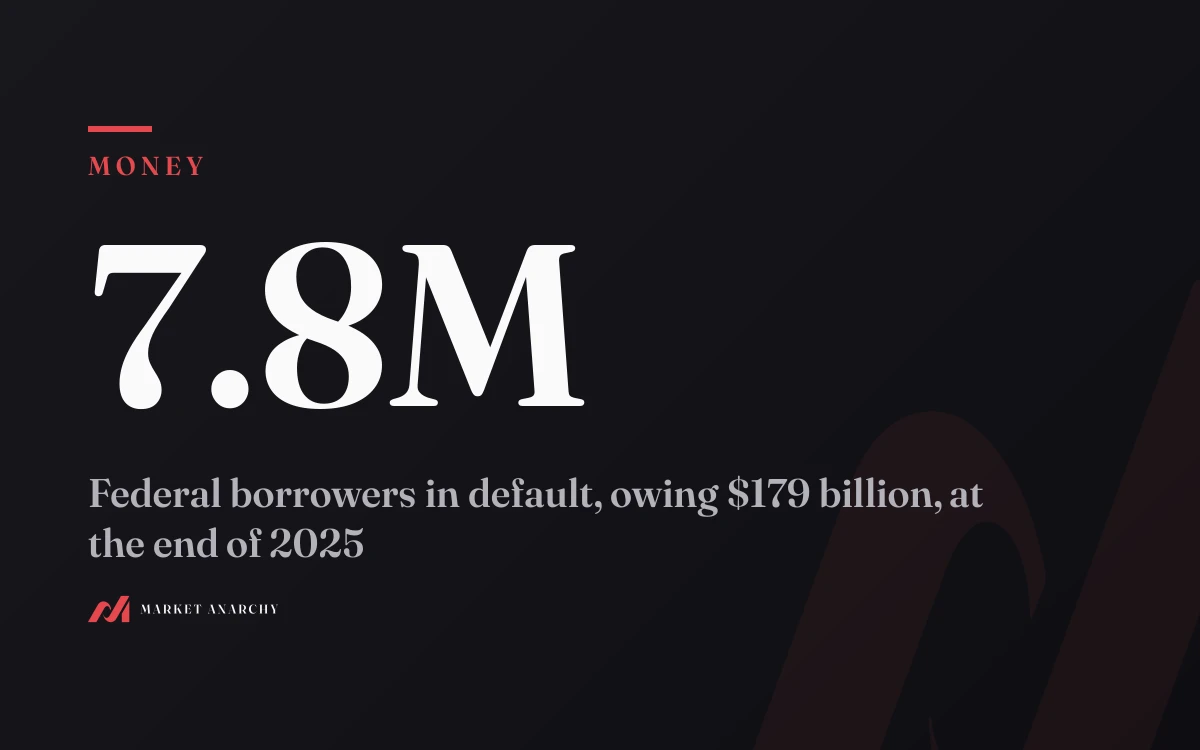
7.8Mfederal borrowers in default, owing $179 billion, at the end of 2025
91%drop in dollars collected from defaulted loans, FY2019 to FY2025
$7.98Bof defaulted loans resolved by rehabilitation in FY2025
4.14%of loans Treasury resolved in its 2015 pilot, against 5.46% for private collectors
If your federal student loan is in default, the agency that will chase it is changing. Under an agreement the Education Department signed with the Treasury on March 19, 2026, Treasury's Bureau of the Fiscal Service takes over collection of about 7.8 million defaulted borrowers owing $179 billion, counted at December 31, 2025. Wage garnishment and tax refund seizures are still paused: the department told Yahoo Finance on October 29 that "involuntary collections remain paused". No restart date has been announced.
The part most coverage skips sits in the agreement's funding clause. The Education Department authorizes Fiscal Service to "assess as costs on student loan debtors" any reasonable amounts Treasury charges it, and Treasury's own regulation says its collection fees "may be added to the debt". So a loan referred to Treasury can carry a second layer of costs on top of what it already owes. A borrower who gets out of default first never sees that layer.
What changes when Treasury holds your defaulted loan
The Education Department used to collect defaulted loans through private collection agencies it hired itself. It cancelled those contracts in November 2021, during the pandemic pause, and collections never recovered. The Congressional Research Service counted the damage in its June 9, 2026 report:
- Total dollars collected from defaulted loans fell from $6.56 billion in FY2019 to $560 million in FY2025, down 91%.
- Wage garnishment brought in $1.34 billion in FY2019 and $0.51 million in FY2025.
- Treasury offsets, mostly seized tax refunds, fell from $4.45 billion to $366 million.
Under the new agreement, Treasury runs the defaulted portfolio through its Cross-Servicing Program. On March 20, Treasury issued a request for information seeking contractors for "default resolution agent" work, which covers demand letters, rehabilitation negotiations and administrative wage garnishment, Credit and Collection News reported on October 20. It named five firms already working the program: The CBE Group, ConServe, Pioneer Credit Recovery, Coast Professional and Transworld Systems.
The agreement sets no timeline. CRS says the timing, steps and resources for the first phase "are unspecified."
$9801M$7984M$4453M$366M$1341M$0.51M
View as table
| label | Defaulted student loans, dollars by method |
|---|---|
| Rehabilitation, FY2019 | $9801M |
| Rehabilitation, FY2025 | $7984M |
| Treasury offset, FY2019 | $4453M |
| Treasury offset, FY2025 | $366M |
| Wage garnishment, FY2019 | $1341M |
| Wage garnishment, FY2025 | $0.51M |
The fee clause, read plainly
Two documents decide what Treasury's involvement can cost you.
The first is the March 19 agreement. CRS quotes it: the Education Department authorizes Fiscal Service to charge debtors referred to the program "any reasonable amounts that Fiscal Services charges FSA." If those costs run higher than the department "would like to have assessed on student loan debtors," the department instructs Treasury and covers the rest, subject to appropriations.
The second is 31 CFR 285.12, the rule for Treasury's cross-servicing. Fiscal Service may set its fees "in any manner designed to cover up to the full cost" of collecting, including as a percentage of what it collects. The fee need not match the cost of your own file. It can be set from the program's overall costs.
Neither document names a rate for student loans. That's our read of the gap: the ceiling is "full cost," the floor is whatever the Education Department chooses to absorb, and nobody has published the number in between. Defaulted loans already carry the department's own collection costs, and payments go to those charges before interest or principal on most plans. A Treasury fee would sit on top.
Can Treasury collect better? Its last try says no
Treasury has run defaulted student loans once before. In a pilot that began in February 2015, the Education Department sent Fiscal Service 16,242 defaulted loans from 5,729 borrowers, about $80 million. After a year, Fiscal Service had resolved 4.14% of them. The department's private collectors, working a control group, resolved 5.46%, and they beat Treasury on every collection and recovery measure in the report. The pilot ended early, in October 2017, and CRS found no final report.
CRS adds that Treasury knows involuntary tools such as garnishment better than voluntary ones such as rehabilitation. Borrowers told Treasury in the pilot that rehabilitation was hard to complete.
The opposing case deserves its place. Treasury can learn from 2015, and it will hire private agents this time instead of doing the calls itself. Starting July 1, 2027, borrowers may also rehabilitate a loan twice instead of once, which widens the door. A better-run Treasury program could resolve more defaults than the department managed in FY2025.
How many borrowers are in default: the numbers don't match
The counts in circulation disagree. CRS says 7.8 million borrowers owing $179 billion at December 31, 2025, about 18% of federal borrowers. Yahoo Finance put it at more than 9.3 million on October 29, 2026, and Credit and Collection News at nearly 10 million on October 20. The later figures likely include borrowers who defaulted during 2026, but neither outlet shows its source. We use the CRS figure because it carries a date and a method.
What Treasury can take once collections restart
The limits are set in law, and the CRS report lists them:
- Wages: up to 15% of disposable pay through administrative wage garnishment.
- Tax refunds: up to 100% of a federal refund through the Treasury Offset Program.
- Social Security: the lesser of 15% of the monthly benefit or the amount above $750. On a $1,000 benefit, that's $150 a month. The 2027 COLA raise is inside that base.
- Federal pay: up to 15% of disposable pay for current and former federal workers.
What to do while the pause holds
The Education Department said on January 16 that it delayed collections so defaulted borrowers could weigh the new repayment options once they consolidate or start rehabilitation. The two exits are the same ones we covered earlier this year, and rehabilitation still does most of the work: it resolved $7.98 billion of defaulted loans in FY2025, against $94 million for consolidation.
- Rehabilitation: nine payments in ten months, at an amount set from your finances. The rule bars setting it as a percentage of your balance. It clears the default from your credit record. Today you get it once per loan.
- Consolidation: fold the defaulted loan into a new Direct Consolidation Loan and choose an income-driven plan. It's faster, and the default stays on your credit history.
Either path started now runs through the Education Department, before any fee layer from Treasury exists. If you wait, the same paths still exist, with the agreement allowing Treasury's costs to be added along the way.
What to watch: a published fee schedule for student loans under cross-servicing, the contract awards from Treasury's March request, and the first garnishment notices. The department must mail written notice at least 30 days before it starts garnishing wages.
Sources
- Congressional Research Service, "Transition of Servicing Defaulted Federal Student Loans to the Department of the Treasury," R48962, updated June 9, 2026
- Yahoo Finance, "Student debt collection may be coming back," October 29, 2026
- Credit and Collection News, "Treasury prepares private student loan collection push," October 20, 2026
- 31 CFR 285.12, Transfer of debts to Treasury for collection, eCFR
- 34 CFR 685.211, Miscellaneous repayment provisions, eCFR
- 34 CFR 34.4, Notice of proposed garnishment, eCFR
- U.S. Department of Education, "Delays involuntary collections," January 16, 2026
This is not financial advice.
More from Money
The IRS's new IRA fix costs $3,500. Heirs never had one before.
From May 2027 the IRS fixes four IRA mistakes for $3,500. Heirs who cashed an inherited IRA on bad advice get a way back, if the refund clock hasn't run out.