Gemini Flash doubles January 1. Its successor already costs that.
Gemini 3.8 Flash goes to $1.50 and $7.50 on January 1, Argon doubles December 1. What one user costs on each model, and the two rates that stay cheap.
By the numbers
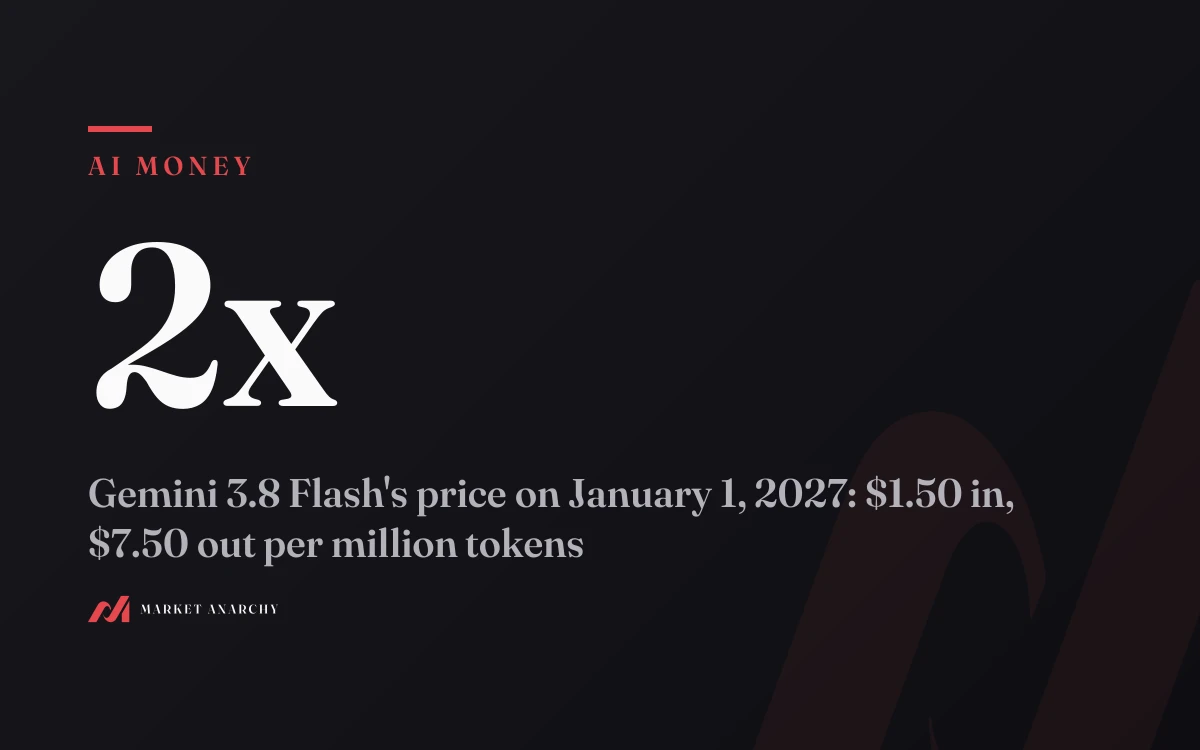
2xGemini 3.8 Flash's price on January 1, 2027: $1.50 in, $7.50 out per million tokens
$1.50 / $7.50Gemini 4 Hydrogen's price from launch, November 12, 2026
51 vs 31Hydrogen (high) against 3.8 Flash on the Artificial Analysis Intelligence Index
$4 / $20Gemini 4 Argon's price from December 1, up from $2 / $10
$0.75 / $3.75Hydrogen's batch price, the same as Flash's price today
On January 1, 2027, Gemini 3.8 Flash costs twice what it costs today: $1.50 per million input tokens and $7.50 per million output tokens, up from $0.75 and $3.75, per Google's price list. Gemini 4 Argon doubles a month sooner, on December 1, to $4 and $20. If your app runs on either, your bill goes up whether you touch anything or not.
The cheaper move is the model Google shipped on November 12. Gemini 4 Hydrogen already costs $1.50 and $7.50, the exact price Flash moves to. On the Artificial Analysis Intelligence Index it scores 51 at its default setting. Flash scores 31. Argon scores 50 and, from December 1, costs more than twice as much per token. So after January 1, staying on Flash means paying Hydrogen's price for a model 20 points behind it, and staying on Argon means paying 2.7 times Hydrogen's rate for one point less.
Two of Hydrogen's rates also keep today's Flash price alive: batch jobs and cached prompts. Those are where the money is.
The Flash price was always going to end
Nobody slipped this in. When Google launched 3.8 Flash on September 2, it called $0.75 and $3.75 an introductory rate, said it expires on December 31, 2026, and named the $1.50 and $7.50 that follow. The same post said the intro price matched 3.7 Flash's launch price. Google has sold the cheap tier at a launch discount two generations running.
What changed this week is that the post-discount price now has a better model attached to it. That turns January 1 from a price rise you absorb into a switch you make.
What one user costs you, model by model
Take an app that makes 300 calls per user per month, each with 8,000 tokens in and 2,000 out. That's our example; plug in your own counts. The prices are Google's, read on November 15, 2026. Output includes thinking tokens: Google bills every token the model produces, reasoning included.
$21.6$10.8$8.1$5.54$4.05
View as table
| label | What one user's month costs on each Gemini option |
|---|---|
| Argon from Dec 1 | $21.6 |
| Argon today | $10.8 |
| Flash from Jan 1, or Hydrogen | $8.1 |
| Hydrogen, 6,000 tokens cached | $5.54 |
| Flash today, or Hydrogen batch | $4.05 |
- 3.8 Flash today: $4.05 a user.
- 3.8 Flash from January 1: $8.10.
- Hydrogen at standard rates: $8.10, the same.
- Argon today: $10.80. From December 1: $21.60.
On a $10 monthly plan, Flash's model cost goes from about 40% of the price to 81% on New Year's Day. Argon at the new rate costs more than the whole plan.
Google adds one more figure: in partner tests, Hydrogen used 12% to 23% fewer tokens than 3.8 Flash on complex workflows. If your calls behave like theirs, Hydrogen's $8.10 becomes something between $6.24 and $7.13. That's Google's number from its own partners, so test it before you book the saving.
Batch keeps the old price
Every Gemini model takes 50% off for batch requests, according to the price list. On Hydrogen that's $0.75 in and $3.75 out, the same as Flash costs today. Anything that doesn't need an answer while the user waits qualifies: nightly summaries, tagging, report generation, bulk classification. For that share of your traffic, the January price rise doesn't exist, and you get the better model.
Caching keeps it for repeated prompts
Most apps send the same long instructions on every call. Hydrogen charges $0.075 per million tokens for cached input, a 95% discount on its input rate. Flash's cached rate is $0.075 today and goes to $0.15 on January 1.
In the example, if 6,000 of the 8,000 input tokens are a fixed system prompt that hits the cache, a Hydrogen user costs $5.54 instead of $8.10. Explicit caches also carry a storage charge of $1 per million tokens per hour; holding a 6,000-token prompt for a 720-hour month comes to about $4.32 for the whole app.
The thinking dial is where you can lose
Hydrogen has four thinking levels: low, medium, high and xhigh, with high the default. The cheaper settings cut tokens, and quality with them. Artificial Analysis puts Hydrogen at 27 on its index at low, which is below 3.8 Flash's 31, and at 54 on xhigh, at an estimated $3.16 per index task against $1.87 on high. Thinking tokens are billed as output at $7.50, so a call left on xhigh can cost more than the switch saved.
The practical read: test on high first, since that's the setting the 51 refers to. Drop to medium only where your own evals hold up.
What to watch before December 1
- If you're on Argon, you have about two weeks before the rate doubles. Hydrogen's score is one point higher on the same index, and Google says so itself: the smaller model has overtaken the larger one.
- If you're on Flash, you have until December 31, and the January bill is the only one that changes. Run Hydrogen on a slice of real traffic now, at today's prices, and measure tokens per finished task, the number Google's partner claim rests on.
- If you sell a flat monthly plan, price on the January figure. A margin built on an introductory rate was dated from the day it was set. Our piece on what a $200 AI plan now buys shows the same squeeze from the subscriber's side, and the cost of lock-in when token prices move is the other half: a model swap is cheap only if your prompts don't depend on one vendor.
A caveat on all of it: index scores measure benchmark tasks. Your app's tasks may be easier, where Flash does fine and the switch buys little, or narrower, where neither score says much. The prices are facts. The scores are a reason to run your own test.
Sources
- Gemini API pricing, Google AI Studio, read November 15, 2026
- Introducing Gemini 4 Hydrogen, Google, November 12, 2026
- Introducing Gemini 3.8 Flash and 3.8 Flash Cyber, Google, September 2, 2026
- Gemini 4 Hydrogen vs Gemini 3.8 Flash, Artificial Analysis, November 2026
- Gemini 4 Argon, Artificial Analysis, November 2026
- Gemini 4 Hydrogen explained, DataCamp, November 13, 2026
This is not financial advice.
More from AI money
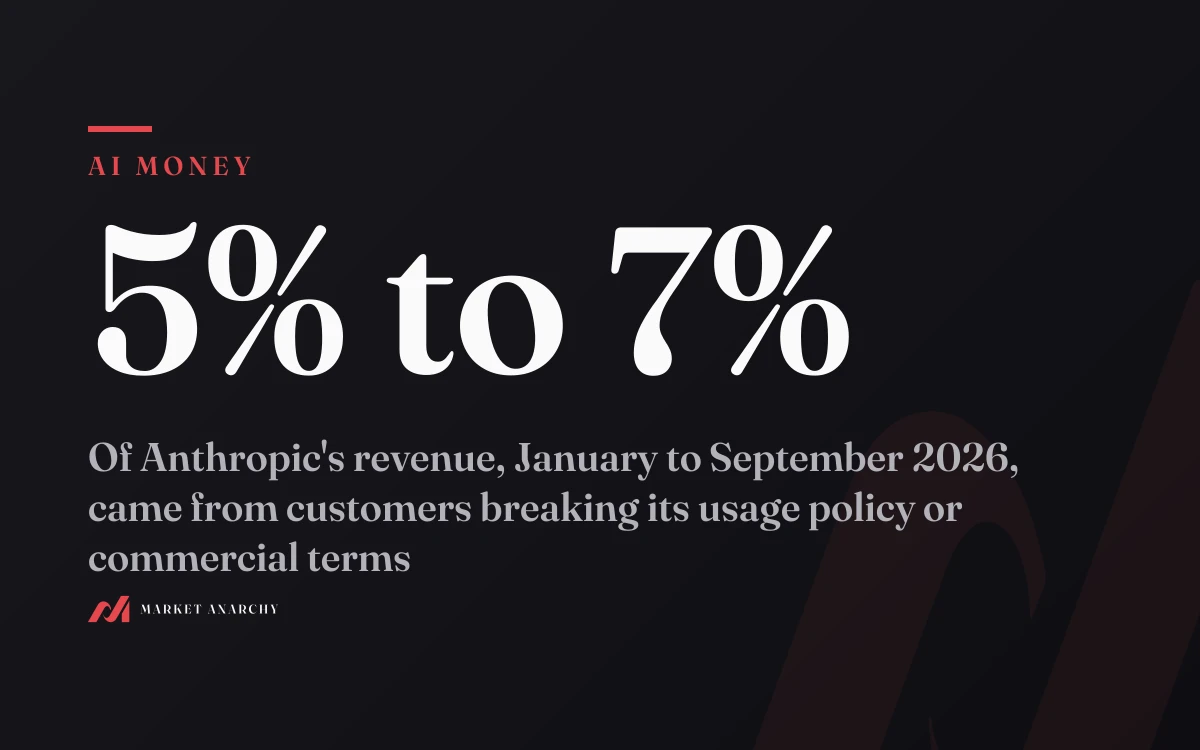
Up to 7% of Anthropic's revenue broke its rules. 1 appeal in 10 wins.
Anthropic's S-1 says 5% to 7% of its 2026 revenue came from rule-breaking customers. It banned 11.4 million accounts in six months and granted 1 appeal in 10.