
The IRS raised 2027 brackets 3.2%. The tips cap stayed at $25,000.
The IRS moved almost 70 tax figures for 2027, brackets up 3.2%. The tips, overtime, senior and car loan breaks stayed frozen. A server on a raise pays $96.
By the numbers
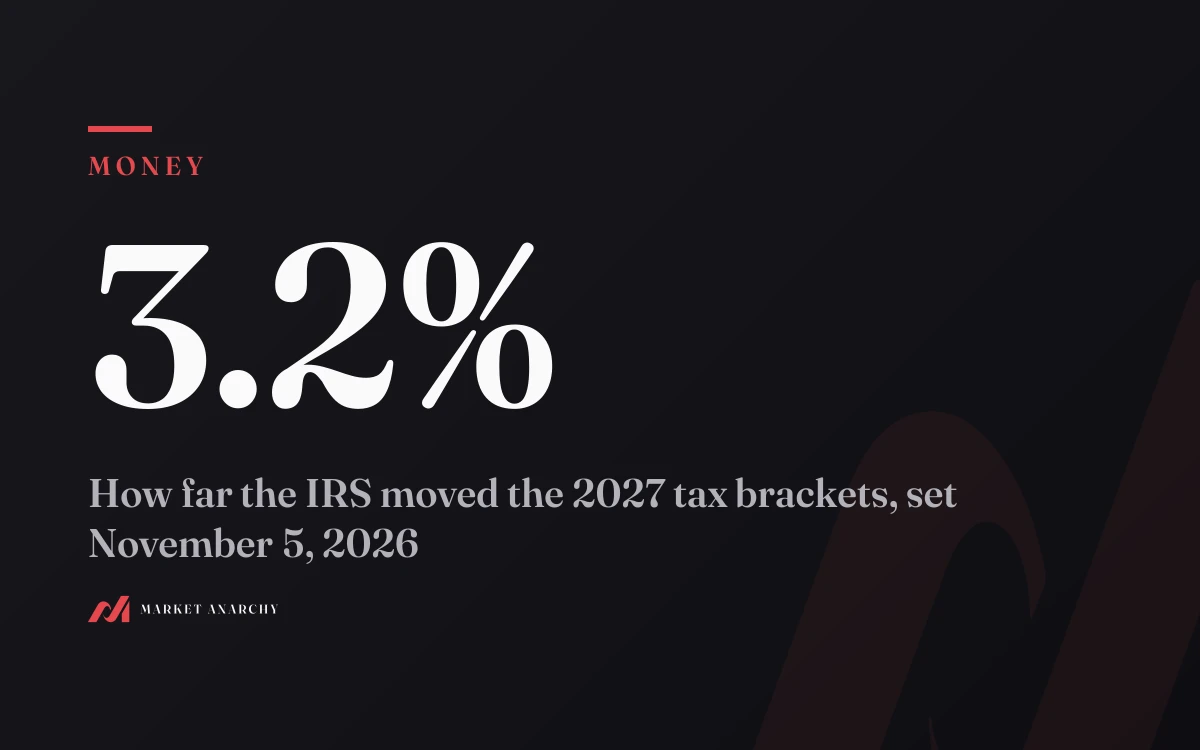
3.2%how far the IRS moved the 2027 tax brackets, set November 5, 2026
$25,000the tips deduction cap, written into law with no inflation adjustment through 2028
$96extra 2027 federal income tax on a server whose tips pass the cap after a 3.2% raise (our calculation)
$200,000the single filer's threshold for the 3.8% investment income tax, unchanged since 2013
3.7%consumer price inflation in the 12 months to September 2026
The IRS published its 2027 numbers on November 5, and most of them moved up about 3.2%. The standard deduction rises to $16,600 for single filers and $33,200 for married couples, the child tax credit to $2,300, and every bracket threshold shifts up (IRS, IR-2026-133, November 5, 2026). The release covers almost 70 provisions.
The newest breaks are missing from it. The $25,000 tips deduction, the $12,500 overtime deduction, the $6,000 senior deduction and the $10,000 car loan interest deduction all stay where the 2025 law put them, because the law gave them no inflation adjustment (IRS fact sheet FS-2025-03, July 2025; Tax Foundation, updated December 10, 2025). Their income limits don't move either. With prices up 3.7% in the year to September (BLS, October 14, 2026), a frozen dollar figure loses real value every year it sits still.
For most people the indexing helps more than the freeze hurts. The people who lose ground are the ones the new breaks were written for: tipped workers near the cap, hourly workers with heavy overtime, and retirees whose income sits in the senior deduction's phase-out.
What the IRS moved for 2027
The adjustment follows the chained consumer price index, a slower measure than the headline CPI (CBS News, September 11, 2026, citing Bloomberg Tax). That's why the brackets rise 3.2% in a year when the headline rate reached 3.7%.
The main figures, 2026 against 2027, from the IRS 2026 release (October 9, 2025) and the 2027 release:
- Standard deduction, single: $16,100 to $16,600.
- Standard deduction, married filing jointly: $32,200 to $33,200.
- Top of the 12% bracket, single: $50,400 to $52,025.
- Top of the 22% bracket, single: $105,700 to $109,125.
- Child tax credit: $2,200 to $2,300, with the refundable part at $1,800 (Journal of Accountancy, November 2026).
- Annual gift exclusion: $19,000 to $20,000.
The release names only a few things that stay put: personal exemptions remain at zero and the Lifetime Learning Credit income limits stay at $80,000 to $90,000 for single filers. The 2025 law's new deductions aren't on that list. They're fixed in the statute, so the IRS has nothing to adjust.
The numbers that stay frozen
| Provision | 2027 amount | Indexed? | At 3.2% it would be |
|---|---|---|---|
| Tips deduction cap | $25,000 | No, through 2028 | $25,800 |
| Overtime deduction cap, single | $12,500 | No, through 2028 | $12,900 |
| Senior deduction, per person | $6,000 | No, through 2028 | $6,192 |
| Car loan interest cap | $10,000 | No, through 2028 | $10,320 |
| Tips and overtime phase-out start, single | $150,000 | No | $154,800 |
| Senior deduction phase-out start, single | $75,000 | No | $77,400 |
| Investment income tax threshold, single | $200,000 | No, since 2013 | n/a |
| Capital loss offset against wages | $3,000 | No | n/a |
Sources: IRS FS-2025-03; IRS NIIT questions and answers, which states the thresholds "are not indexed for inflation"; IRS Topic 409. The last column is our arithmetic.
The SALT cap sits in between. It rises 1% a year, from $40,400 in 2026 to about $40,804 in 2027, then falls back to $10,000 in 2030 (24/7 Wall St., November 3, 2026). One percent is under a third of this year's adjustment.
What the freeze costs a server on a 3.2% raise
Take a single server who earned $30,000 in wages and $25,000 in tips in 2026, and gets a raise that matches the IRS adjustment: $30,960 in wages and $25,800 in tips in 2027. These are our calculations from the IRS figures above, federal income tax only.
- 2026: $55,000 of income, minus the $16,100 standard deduction and $25,000 of tips, leaves $13,900 taxable. Tax: $1,420.
- 2027: $56,760 of income, minus $16,600 and the same $25,000 cap, leaves $15,160 taxable. Tax: $1,563.
- 2027 with an indexed cap: the full $25,800 of tips comes off, leaving $14,360 taxable. Tax: $1,467.
The frozen cap costs her $96. Her pay rose 3.2% and her federal income tax rose 10%. With the cap indexed, her tax would have risen 3.3%, in step with her pay.
Overtime works the same way. A single worker at the $12,500 cap whose overtime rises 3.2% has $400 the deduction no longer covers: $48 more tax in the 12% bracket, $88 in the 22% bracket.
$1420$1467$1563
View as table
| label | A server's federal income tax, tips cap frozen vs indexed |
|---|---|
| 2026 tax | $1420 |
| 2027, cap indexed to $25,800 | $1467 |
| 2027, cap frozen at $25,000 | $1563 |
Where retirees lose: the phase-out
The senior deduction shrinks by $60 for every $1,000 of modified AGI above $75,000 for a single filer, or $150,000 for a couple (UHY, December 2025). That starting line doesn't move.
A single retiree with $80,000 of modified AGI in 2026 keeps $5,700 of the deduction. If that income rises 3.2% to $82,560 in 2027, the deduction drops to about $5,546. The retiree is no richer in real terms and loses $154 of deduction, roughly $34 of tax in the 22% bracket. It's the same mechanism as the Social Security thresholds set in 1983 and never indexed, which we covered with the 2027 COLA.
The case that this is small
The amounts are small, and that argument deserves its place. The four new deductions expire after 2028, so the freeze runs two more years at most. The indexed parts of the code still do work: with no adjustment at all, the server's 2027 tax would be $1,631, so the moved standard deduction and brackets save her $68 (our calculation). And Congress can index or extend the breaks before they lapse, which would likely reset the frozen figures.
The investment income tax is the opposite case. Its $200,000 line has been fixed since 2013, it has no end date, and every year of inflation pulls more salaried households over it.
What to do with this
- Tipped and overtime workers near the caps: estimate 2027 tips or overtime against $25,000 or $12,500, not a bigger number. Raise withholding if a raise will push you over. Our guide to what freelancers owe the IRS covers estimated payments if part of your income is self-employed.
- Retirees between $75,000 and $175,000 of modified AGI: the timing of IRA withdrawals and capital gains now moves the senior deduction, and the starting line won't rise to meet you.
- Everyone else: the 3.2% applies to your brackets and standard deduction on its own. There's nothing to file.
What to watch: any bill that extends the 2028 breaks, and whether it indexes them this time.
Sources
- IRS, IR-2026-133, Tax inflation adjustments for tax year 2027, November 5, 2026
- IRS, IR-2025-103, Tax inflation adjustments for tax year 2026, October 9, 2025
- IRS, FS-2025-03, Tax deductions for working Americans and seniors, July 2025
- IRS, Questions and answers on the Net Investment Income Tax
- IRS, Topic 409, Capital gains and losses
- BLS, Consumer Price Index, September 2026, October 14, 2026
- Journal of Accountancy, IRS announces inflation adjustments for tax year 2027, November 2026
- CBS News, 2027 tax brackets, September 11, 2026
- Tax Foundation, One Big Beautiful Bill Act tax changes, updated December 10, 2025
- UHY, Senior bonus deduction: how the new $6,000 break works, December 2025
- 24/7 Wall St., The SALT cap jumped from $10,000 to $40,000, November 3, 2026
This is not financial advice.
More from Money
Auto rollovers cut 401(k) cash-outs to 9%. 94% are still parked.
Automatic 401(k) rollovers cut small-balance cash-outs from 50% to 9%. Then 94% of the money sits in interim IRAs paying fees. How to move yours.